Counting Pairs under Dynamic Binary Bounds — Solution
Method and contribution
Use classical digit DP, segment-tree matrix products and inclusion-exclusion. Codex (GPT-6) derives the problem-specific states, comparable-mask compression, inversion and standard C++17 implementation. Reference program.
One state for all five bounds
Process bits of \(a,b\) from most significant to least significant. Each column has four bit pairs, producing the five comparison bits
A five-bit set \(S\) records comparisons whose prefixes are already strictly smaller, or which are deliberately ignored. Comparisons outside \(S\) still have equal prefixes.
For an equal-prefix comparison, a bit above the bound is invalid; a smaller bit inserts that comparison into \(S\) ; an equal bit leaves it unchanged. A comparison already in \(S\) places no restriction on later bits. Transitions can only add elements.
The figure starts with an empty set and five bound bits equal to one. The four choices of \((a_i,b_i)\) produce the displayed loose sets. Letters identify the bounds whose prefixes have become strictly smaller.
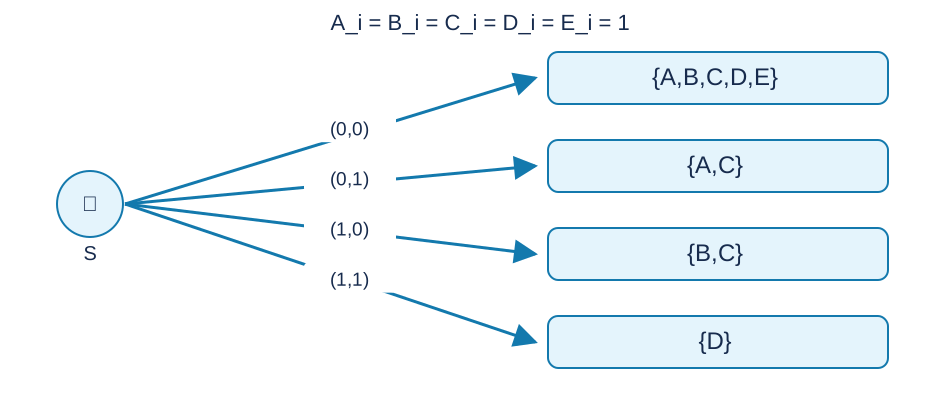
Integer comparison is determined by the first differing bit, which proves the state rule. A smaller prefix allows every suffix, and equality through the final bit also satisfies an upper bound. Since \(a\le A,b\le B\) , values requiring more than \(n\) bits need not be considered.
Compressed matrix products
One column gives a matrix \(M[S,T]\) counting bit pairs that transform \(S\) into \(T\) . Only \(S\subseteq T\) is possible. Each comparison has three statuses in such a pair of sets: absent from both, present only in the latter, or present in both. There are therefore \(3^c\) entries, where \(c=5\) is the number of comparisons.
For adjacent intervals,
A comparison has four possible statuses in this three-set chain, giving \(4^c\) product terms. Entry IDs and product indices are precomputed: 243 entries and 1024 terms here.
A segment tree maintains the product in high-to-low bit order; multiplication is not commutative. Padding leaves use identity matrices. Bit \(y\) counted from the right is zero-based position \(n-y\) from the left. Rebuild that leaf and its ancestors. Reduce every eight product terms modulo the modulus so a sum of up to thirty-two products cannot overflow unsigned 64-bit arithmetic.
From required subsets to exact counts
For a subset \(K\) of the three extra conditions, let \(F(K)\) count pairs satisfying the two basic bounds and every condition in \(K\) . Other conditions may hold or fail.
Initially mark the unrequired extra comparisons loose while keeping the \(A,B\) comparisons equal. Summing the corresponding row of the root product gives \(F(K)\) . Ignored comparisons never restrict any bit, which is exactly the required meaning.
Define
A pair satisfying exactly \(t\) extra conditions contributes \(\binom tj\) to \(E_j\) . Inverting this triangular relation gives the desired counts:
All arithmetic is modulo \(998244353\) ; normalize subtraction into the standard residue range. A sequence of bit choices identifies one pair uniquely, and the inversion places every pair into exactly one category.
Complexity
Building takes \(O(4^c n)\) time, updating takes \(O(4^c\log n)\) , and extracting counts takes at most \(O(3^c)\) . Total time is \(O(4^c(n+m\log n))\) with \(O(3^c n)\) space. Here \(c\) is the number of comparisons, fixed at five, and differs from the bit length \(n\) . Storing only comparable entries fits the original 128 MB limit. Even when there are no updates, print the initial counts.
Data and reproduction
The statement contains three samples. The test plan defines ten scored inputs. The generator uses only the Python standard library and accepts --plan, --out-dir, --case and --std. Large generated inputs and executables are kept outside the published package. See the reference measurements for runtime and memory.