Partitions into Powers of Two: Solution
Problem setter’s solution: a three-dimensional DP for power-of-two blocks. GPT-6 adds the unique-splitting proof and suffix-sum acceleration.
1. States for one block
Let \(C_{i,j,k}\) count nondecreasing partitions of \(2^j\) with smallest exponent exactly \(i\) and largest exponent exactly \(k\) . Necessarily \(0\le i\le k\le j\) .
The unsplit block gives \(C_{j,j,j}=1\) . Every other partition uses terms at most \(2^{j-1}\) and can be cut uniquely into two consecutive halves of sum \(2^{j-1}\) each.
To see why a cut cannot be skipped, let the next term be \(v\) . All following terms are multiples of \(v\) , and the total is also a multiple of \(v\) , so the preceding prefix sum is a multiple of \(v\) . The target \(2^{j-1}\) is likewise a multiple of \(v\) . Adding one \(v\) cannot jump over it. Positive terms make the cut unique.
If the left half’s largest exponent is \(l\) and the right half’s smallest exponent is \(r\) , sorted order requires \(l\le r\) . Thus, for \(k<j\) ,
Endpoint exponents identify the states, and the unique cut prevents both omissions and duplicate counts.
The direct setter recurrence takes \(O(L^5)\) time and \(O(L^3)\) space, where \(L\) is the bit length.
2. Suffix-sum acceleration
For fixed \(j,k\) , compute
by scanning \(l\) downwards. Then use
Eliminating the innermost loop reduces time to \(O(L^4)\) while preserving \(O(L^3)\) space. This is the same state model and counting recurrence; the reference program uses the accelerated form.
3. Assemble a general integer
Write the set-bit positions of \(N\) as \(b_0<\cdots<b_{t-1}\) . Every valid nondecreasing partition has a unique division into consecutive blocks with sums \(2^{b_0},\ldots,2^{b_{t-1}}\) .
First consider \(T=2^{b_0}\) . If a prefix is still below \(T\) and the next term \(v\) exceeds \(T\) , all remaining terms are multiples of \(v\) . The prefix must equal \(N\bmod v\) , which is at least \(T\) because \(T\) is the lowest set bit: a contradiction. Hence the next term cannot exceed \(T\) before the cut. The divisibility argument above then prevents jumping over \(T\) . Remove the first block and repeat.
Let \(G_p(x)\) count assemblies starting at block \(p\) whose exponents are all at least \(x\) . The empty suffix satisfies \(G_t(x)=1\) . For \(b=b_p\) ,
Requiring subsequent exponents to be at least the current maximum \(k\) exactly enforces global nondecreasing order. Compute the inner sum for each exact minimum \(i\) , then take suffix sums over \(i\) . All assembly steps take \(O(L^3)\) time. The answer is \(G_0(0)\) .
4. Boundaries and complexity
For \(N=0\) , return one. Other inputs have at most \(63\) bits, so indices are only \(0,\ldots,62\) and no shift reaches the type width.
Only addition, multiplication, and reduction are used; the modulus need not be prime. A product of two reduced values plus a reduced accumulator is below \(10^{18}\) , so signed 64-bit arithmetic suffices.
Total time is \(O(L^4)\) and space is \(O(L^3)\) . Ordinary coin-change DP needs a number of states proportional to \(N\) and is useful only for small-instance verification.
Illustration
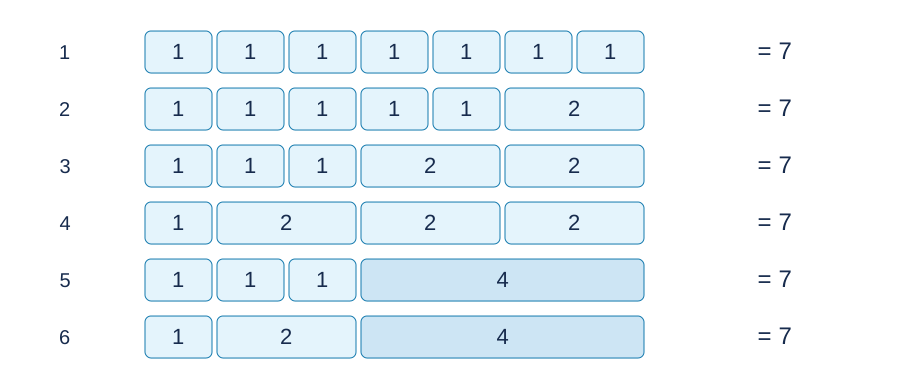
The six rows show every nondecreasing partition of \(N=7\) . Each rectangle’s value and width represent one power of two; the numbers on the left are just row indices.
Data and reproduction
The statement contains three samples. The test plan defines ten scored inputs. The generator uses only the Python standard library and accepts --plan, --out-dir, --case and --std. Large generated inputs and executables stay outside the published package. See the reference measurements for runtime and memory.