Paired DNA Strands with Many Pair Types
Estimated time limit: 0.5 seconds. Memory limit: 128 MB.
The actual time limit is twice the slowest-case median runtime of the reference solution on the target judge, rounded up to a multiple of \(0.5\) seconds. See the benchmark environment.
Story
Extend the model of double-stranded, non-circular DNA to an alphabet with many complementary letter pairs. Each query may use a different length, number of pair types, and modulus.
Formal Problem Statement
A query gives \(N,K,P\) . The alphabet has \(K\) pairs of distinct letters \(a_1,b_1,\ldots,a_K,b_K\) , for \(2K\) letters in total. Letter \(a_i\) complements \(b_i\) . Letters from different pairs do not complement each other, and no letter complements itself.
A double-stranded structure with \(N\) letter pairs is represented by a string \(s\) of length \(N\) . Reverse complementation is
Two strings describe the same structure exactly when they are equal or one is the reverse complement of the other. Letter types have fixed labels; renaming different complementary pairs does not create additional identifications.
Find the least nonnegative residue of the number of structures modulo \(P\) . There are \(M\) queries; output the bitwise XOR of all their residues.
Input Format
The first line contains \(M\) . Each of the next \(M\) lines contains \(N,K,P\) . The letters themselves are not input; their pairing is defined above.
Output Format
Print one nonnegative integer: reduce each query count modulo its own \(P\) , then XOR all results.
Samples
Sample 1
Input
3
1 1 100
2 1 100
3 2 100
Output
34
Sample 2
Input
4
2 2 2
4 1 4
4 2 1
1 5 7
Output
7
Sample 3
Input
1
2 3 6
Output
3
Sample Explanation
The three counts in the first sample are \(1,3,32\) , each below its modulus, and their XOR is \(34\) . The second sample gives residues \(0,2,0,5\) , whose XOR is seven. A modulus of one always gives residue zero.
The third sample has six letters and length two. There are \(21\) structure types, giving residue three modulo six.
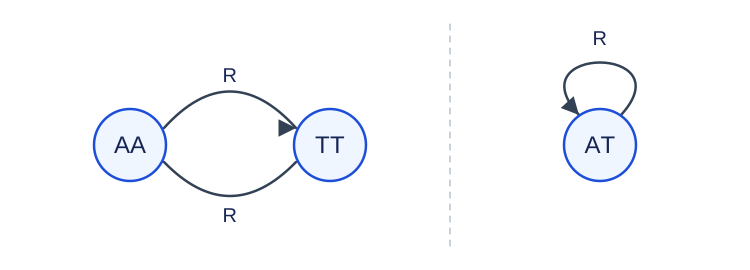
Here A , T denote any complementary pair. Arrows apply reverse complementation; each diagram is one equivalence class.
Constraints and Guarantees
For all inputs, \(1\le M\le500000\) and \(1\le N,K,P\le10^9\) . Modulus \(P\) may be one, even, or composite. Queries may repeat.
| Score share | Additional conditions |
|---|---|
| 100% | None |