Ordered Tree Construction with a Given Leaf Count
Story
A park builds passages one at a time between numbered stations. The completed network must be a tree with a specified number of terminal stations. Count the different construction records.
(This story was rewritten by GPT-6.)
Formal Problem Statement
There are \(n\) vertices labeled \(1,\ldots,n\) , initially without edges. Add undirected edges between distinct vertices, with at most one edge per pair. The final graph must be a tree with exactly \(m\) vertices of degree at most \(1\) , called leaves.
Different final edges or different insertion orders of the same edges count as different plans. Every vertex, including every leaf, has a distinct label. Print the count modulo \(998244353\) as a nonnegative residue.
For \(n=0\) , the empty sequence is the only plan and has \(0\) leaves. For \(n=1\) , the sole vertex is a leaf.
Input Format
One line containing nonnegative integers n m .
Output Format
Print the number of plans modulo \(998244353\) on one line.
Sample 1
Input
3 2
Output
6
Sample 2
Input
4 2
Output
72
Sample 3
Input
4 3
Output
24
Sample 4
Input
1 0
Output
0
Sample Explanation
For three vertices, three trees each allow two edge orders, giving 6. Four-vertex trees with two leaves are paths: 12 trees and six orders each give 72. Three leaves require a star: four stars give 24 orders. A singleton cannot have zero leaves.
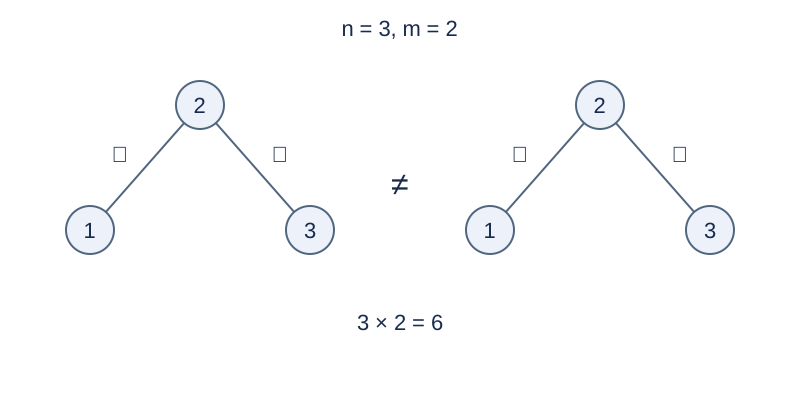
A different center label or edge insertion order gives a different record.
Constraints and Scoring
\(0\le n,m\le10^5\) . It is not guaranteed that \(m\le n\) ; print zero if no plan exists.
Specifications redesigned by Codex (GPT-6): the empty case, singleton leaves, and counting by labels and insertion order.
| Score | Additional constraints |
|---|---|
| 20% | \(n\le8\) |
| 30% | \(n\le1000\) |
| 50% | No additional constraints |
Resource Limits
Time: 0.5 seconds. Memory: 128 MiB. The limit is twice the slowest standard-program median over five runs per input, rounded up to 0.5 seconds.