A Conveyor with Limited Capacity
Indicative time limit: 1 seconds. Memory limit: 8 MiB. Recalibrate as twice the slowest standard median in the target environment, rounded up to 0.5 seconds. See the environment.
Story
A laboratory transports research bottles on an expensive conveyor with limited capacity. An arm adds bottles at the tail and removes them from the head. Simulate the requested operations.
Formal Problem Statement
An initially empty queue holds at most \(n\) signed integers. Process \(m\) operations in order:
1 x: append \(x\) at the tail if the queue currently contains fewer than \(n\) elements; otherwise ignore the operation.2: if the queue is nonempty, print and remove its head; otherwise ignore the operation and print nothing.
Values may be zero or negative. Both kinds of operation are ignored when the capacity is zero. Encapsulate the queue in a structure.
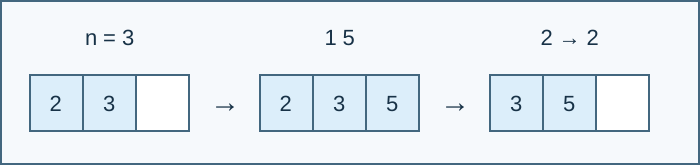
From left to right: before inserting 5, after inserting 5, and after removing 2. The left end of each list is the head.
Input Format
The first line contains n m . Each of the next \(m\) lines describes one operation.
Output Format
Print one integer for each successful 2 operation. The output is empty if no removal succeeds.
Sample 1
Input
3 11
1 1
2
2
1 2
1 3
1 4
1 5
2
2
2
2
Output
1
2
3
4
Sample 2
Input
0 3
1 0
2
2
Output
Sample 3
Input
1 6
1 -2147483648
1 7
2
1 0
2
2
Output
-2147483648
0
Constraints and Scoring
\(0\le n\le500000\) , \(0\le m\le3000000\) , and \(-2^{31}\le x\le2^{31}-1\) .
Specification adjustment by Codex (GPT-6), recorded as a redesign: the whole-process memory limit is 8 MiB to accommodate the reference Windows runtime overhead. The input domain and counting or queue rules are unchanged.
| Score | Additional constraints |
|---|---|
| 100% | None |
There are 10 formal files worth 10% each. See the test recipes.