Danjin's Canisters
- Indicative time limit: 1.5 seconds (environment and measurements).
- Actual limit: measure the reference solution on the target system, take the largest median time over test files, multiply by 2, and round up to a multiple of 0.5 seconds.
- Memory limit: 128 MB.
Story
“Absolutely none of them are empty!”
“Hehe, surely an empty one now and then is understandable.”
Danjin arranges his canisters in a row, each with a type. To change the display, he may replace the types in a range, reverse a range, or move a whole segment elsewhere. He also wants to know how many consecutive runs of one type appear in a queried range.
Formal Problem Statement
You are given a sequence of length \(n\) , with positions \(1,\ldots,n\) and initial types \(v_1,\ldots,v_n\) . Process \(m\) operations in order:
1 l r v: set every type in \([l,r]\) to \(v\) .2 l r: reverse the order of \([l,r]\) .3 l len nl: remove the segment of length \(\mathrm{len}\) starting at position \(l\) , keeping its internal order. Renumber the remaining sequence from \(1\) , then insert the removed segment so that it occupies \([\mathrm{nl},\mathrm{nl}+\mathrm{len}-1]\) in the final sequence. Equivalently, insert it after the first \(\mathrm{nl}-1\) remaining elements.4 l r: output the number of consecutive equal-type runs in \([l,r]\) . Equivalently, the answer is \(1\) plus the number of adjacent pairs with different types inside the range.
Every operation uses the current sequence positions. In operation 3, \(\mathrm{nl}\) is interpreted relative to the remaining sequence after removal, and insertion at either end is allowed. The total length always remains \(n\) .
Input Format
The first line contains \(n,m\) . The second line contains \(v_1,\ldots,v_n\) . Each of the next \(m\) lines contains an operation in the format above.
Output Format
For each operation 4, output one integer on its own line, in query order.
Sample 1
Input
6 6
1 1 2 2 3 3
4 1 6
2 2 3
4 1 6
4 2 3
1 5 5 7
4 1 6
Output
3
5
2
6
Sample 2
Input
5 7
1 2 2 3 1
3 2 2 4
4 1 5
2 1 5
4 1 3
1 2 4 2
3 1 5 1
4 1 5
Output
4
2
2
Sample 3
Input
1 5
7
3 1 1 1
2 1 1
1 1 1 9
4 1 1
4 1 1
Output
1
1
Sample Explanation
After the first reversal in sample 1, the sequence is \([1,2,1,2,3,3]\) . It has \(5\) runs in total, while positions \(2,3\) contain \(2\) runs.
Sample 2 first removes the two elements at positions \(2,3\) , leaving \([1,3,1]\) . Inserting the removed segment at the end produces \([1,3,1,2,2]\) .
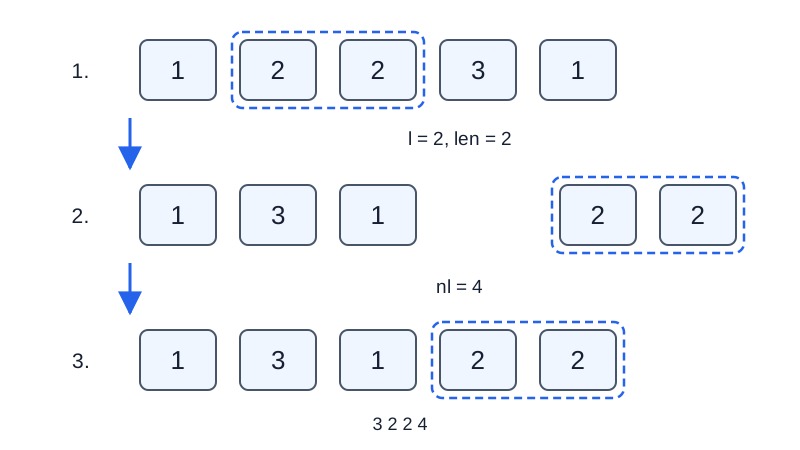
Dashed outlines identify the moved segment; numbers indicate types. Sample 3 covers moving, reversing and assigning a sequence with one element.
Constraints and Guarantees
For all test cases: \(1\le n,m\le200000\) , and every initial or assigned type satisfies \(1\le v\le10^9\) .
Operations 1, 2 and 4 have \(1\le l\le r\le n\) . Operation 3 has \(1\le l\le n\) , \(1\le\mathrm{len}\le n-l+1\) , and \(1\le\mathrm{nl}\le n-\mathrm{len}+1\) .
| Score share | Additional conditions |
|---|---|
| 100% | None |