Catalyst Sequence
- Indicative time limit: 5.0 seconds.
- Judge time limit: twice the reference program’s largest per-case median on the target platform, rounded up to a multiple of 0.5 seconds.
- Memory limit: 128 MB.
- Reference environment and measurements
Story
An adventurer lines up crafting materials in the order they were obtained. The closer two energy values are, the lower the resulting catalyst’s separation level. For each level, find the longest consecutive batch of materials.
Formal Problem Statement
Given positive integers \(a_1,\ldots,a_n\) , let \(U=\max_i a_i\) .
For a contiguous interval \([l,r]\) containing at least two elements, define its separation level as
For every integer \(d=0,1,\ldots,U-1\) , find the maximum length of an interval whose level is exactly \(d\) . Output \(0\) if no such interval exists.
Equal values may occur at different positions. A single element is not a valid interval.
Input
The first line contains \(n\) . The second line contains \(a_1,\ldots,a_n\) .
Output
Print \(U\) lines. Line \(d+1\) contains the maximum interval length for level \(d\) .
Sample 1
Input
10
1 3 2 1 4 7 9 8 2 3
Output
10
7
4
3
0
0
2
0
0
Sample 2
Input
1
1
Output
0
Sample 3
Input
3
1 3 5
Output
0
0
3
0
0
Sample Explanation
In sample 1, the whole sequence contains equal values and has level \(0\) . The seven distinct values in \([2,8]\) include consecutive integers, so this interval has level \(1\) . Sample 2 has no interval of length at least \(2\) . The whole interval in sample 3 has level \(2\) .
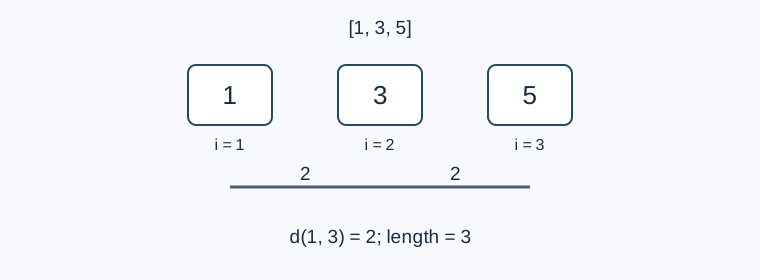
The entire interval in sample 3 has length \(3\) and level \(2\) .
Constraints and Guarantees
\(1\le n\le100000\) ; \(1\le a_i\le250000\) .
| Score | Additional conditions |
|---|---|
| 100% | None |