Interval Top Half
Estimated time limit: 0.5 seconds. Memory limit: 128 MB.
On the target judge, multiply the reference program's largest per-case median time by \(2\) and round up to a multiple of \(0.5\) seconds. See environment and measurements.
Story
An observatory records a sequence of measurements. For every contiguous observation period, a researcher wants the sum of the larger half of its values.
(This story was rewritten by GPT-6.)
Formal Problem Statement
Given an integer sequence \(a_1,\ldots,a_n\) , consider every nonempty contiguous interval \([l,r]\) . Let \(L=r-l+1\) . Find the sum of the largest \(\lceil L/2\rceil\) elements in that interval.
Equal values at different positions count separately. Select exactly the specified number of elements, even when values are negative.
Input Format
The first line contains \(n\) . The second line contains \(n\) integers \(a_1,\ldots,a_n\) .
Output Format
Print \(n(n+1)/2\) lines, each containing one integer. Order intervals by increasing length, and then by increasing left endpoint.
For example, when \(n=3\) , the order is \([1,1]\) , \([2,2]\) , \([3,3]\) , \([1,2]\) , \([2,3]\) , \([1,3]\) .
Examples
Example 1
Input
5
2 3 9 9 1
Output
2
3
9
9
1
3
9
9
9
12
18
18
18
18
21
Example 2
Input
4
-5 0 -5 8
Output
-5
0
-5
8
0
0
8
-5
8
8
Example 3
Input
1
1000000000
Output
1000000000
Example Explanation
The full interval in the first example sorts to \(1,2,3,9,9\) . Its three largest elements sum to \(21\) . In the second example, a one-element interval must select its element even when it is negative.
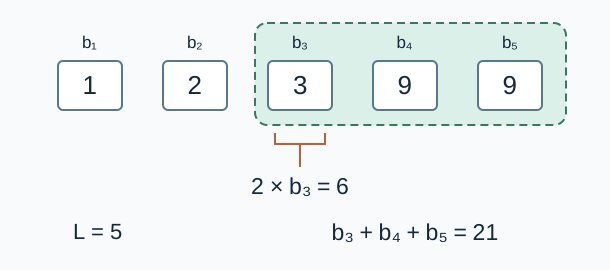
Here \(b_i\) is the \(i\)-th sorted value. The dashed box encloses the three largest values. Twice the middle element is also shown to distinguish the two statistics.
Constraints and Guarantees
All inputs satisfy: \(1\le n\le10^3\) and \(\lvert a_i\rvert\le10^9\) .
| Score | Additional conditions |
|---|---|
| 100% | None |