Torch Lighting
- Indicative time limit: 1.0 seconds (reference environment: environment and measurements)
- Actual time limit: twice the reference program's baseline time on the slowest official test file in the target environment, rounded up to a multiple of 0.5 seconds; round up further if the platform requires a coarser unit.
- Memory limit: 128 MB
Story
The village chief has opened a new farm and wants to illuminate it with torches to prevent monsters from spawning. Some locations contain dark sources that reduce brightness. Every source has a limited range. Count the cells where monsters may still spawn after all sources take effect.
Formal Problem Statement
The farm is an \(n\)-row, \(m\)-column grid with rows and columns numbered from \(1\) . Position \((i,j)\) has light value \(L_{i,j}\) , radius \(R_{i,j}\) , and spawn threshold \(D_{i,j}\) . Every cell initially has brightness zero.
Source \((i,j)\) adds \(L_{i,j}\) to every farm cell \((x,y)\) satisfying
All contributions add together. Negative light values reduce brightness. Radius zero affects no cells, and positions outside the farm are ignored.
A monster may spawn in a cell if its final brightness is at most that cell's \(D_{i,j}\) . Count these cells.
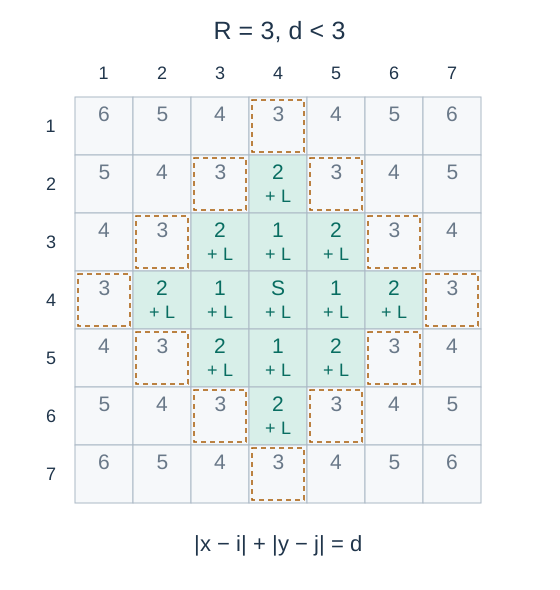
Figure 1: With source \(S\) and \(R=3\) , only cells marked \(+\) receive light. Numbers show Manhattan distance from the source.
Input Format
The first line contains \(n,m\) . Each of the next \(n\) lines contains \(m\) pairs \(L_{i,j},R_{i,j}\) , in increasing column order. The final \(n\) lines contain \(m\) integers each, giving the thresholds \(D_{i,j}\) .
Output Format
Print the number of cells where monsters may spawn.
Sample 1
Input
7 5
0 0 0 0 0 0 0 0 0 0
0 0 0 0 0 0 0 0 0 0
0 0 0 0 1 3 0 0 0 0
0 0 0 0 0 0 0 0 0 0
0 0 0 0 0 0 0 0 0 0
0 0 0 0 0 0 0 0 0 0
0 0 0 0 0 0 0 0 1 1
0 0 0 0 0
0 0 0 0 0
0 0 0 0 0
0 0 0 0 0
0 0 0 0 0
0 0 0 0 0
0 0 0 0 0
Output
21
Explanation
The source at \((3,3)\) illuminates \(13\) cells, and the source at \((7,5)\) illuminates only itself. Their ranges do not overlap, leaving \(35-14=21\) cells at brightness zero.
Sample 2
Input
1 3
10 1 -3 2 8 0
7 -3 -3
Output
3
Explanation
Final brightness values are \(7,-3,-3\) , exactly equal to the corresponding thresholds. All three cells are counted. The radius-zero source contributes nothing.
Constraints and Guarantees
- \(1\le n,m\le2200\) .
- \(0\le R_{i,j}\le100000\) , \(|L_{i,j}|\le10^8\) , and \(|D_{i,j}|\le10^{15}\) .
Test Groups
| Score share | Additional conditions |
|---|---|
| 30% | \(n,m\le80\) |
| 20% | \(n,m\le300\) |
| 30% | \(n,m\le1500\) |
| 20% | No additional conditions |