Interstellar Orders: Intersection Types
Estimated time limit: 0.5 seconds. Memory limit: 128 MB.
On the target judge, use twice the largest per-case median runtime of the reference program, rounded up to a multiple of \(0.5\) seconds. See the reference environment.
Story
The geometry exercises also need labels describing the shared region. The computing center must distinguish an area, a segment, a point, and an empty intersection.
Formal Problem Statement
Given two closed axis-aligned rectangles \(A,B\) in the plane, classify \(A\cap B\) . Each rectangle includes its boundary and is specified by a pair of opposite corners in either order. It may degenerate into a segment or point.
Use these mutually exclusive cases:
- A common region with positive area: output
Area. - A common segment of positive length: output
Edge. - Exactly one common point: output
Point. - No common point: output
None.
Edge includes a segment lying entirely inside the other rectangle; it need not lie on the boundaries of both shapes. Two segments crossing at one point give Point .
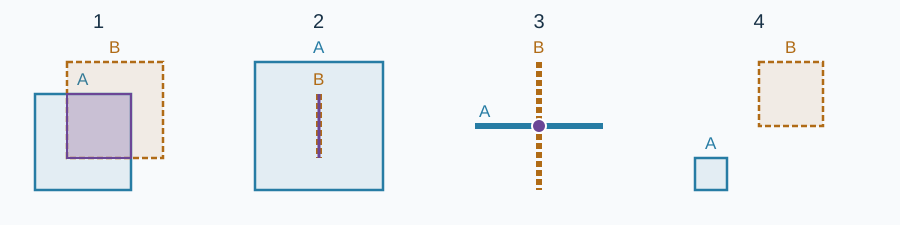
Solid outlines represent \(A\) and dashed outlines represent \(B\) . From left to right, the answers are Area , Edge , Point , and None .
Input
The first line contains \(T\) . Each of the next \(T\) lines contains eight integers:
x1 y1 x2 y2 x3 y3 x4 y4
The first four numbers specify the opposite corners of \(A\) , and the last four those of \(B\) .
Output
Output \(T\) lines, each containing one of Area , Edge , Point , or None . For \(T=0\) , the output is empty.
Samples
Sample 1
Input
12
0 0 1 1 2 2 3 3
-1 2 2 -1 0 0 1 1
0 0 0 0 0 0 0 0
0 1 0 5 0 2 0 3
0 0 5 5 2 -5 3 0
0 0 5 0 2 -1 2 2
0 0 2 2 -1 -1 1 1
0 0 0 0 5 0 -1 0
-1 -1 -5 -5 -5 0 -5 -2
-1 -1 -5 -5 -2 -1 -2 -2
-2 1 2 -1 1 2 -1 -2
0 0 2 2 0 1 -1 1
Output
None
Area
Point
Edge
Edge
Point
Area
Point
Edge
Edge
Area
Point
Sample 2
Input
4
0 0 4 4 2 1 2 3
0 2 4 2 2 0 2 4
0 0 1 1 2 2 3 3
4 4 0 0 3 3 1 1
Output
Edge
Point
None
Area
Sample 3
Input
0
Output
Sample Explanation
In the tenth pair of sample 1, the rectangle is \([-5,-1]\times[-5,-1]\) , while the other shape is the segment from \((-2,-1)\) to \((-2,-2)\) . Their intersection has length \(1\) , so the answer is Edge .
Sample 2 illustrates a contained segment, crossing segments, disjoint shapes, and containment with positive area.
Constraints and Guarantees
For 100% of the data: \(0\le T\le1000\) and \(|x_i|,|y_i|\le10^9\) for \(1\le i\le4\) . Each shape may be a positive-area rectangle, a positive-length segment, or a point. In the table, “rectangle” means positive area and “segment” means positive length.
| Score | Additional conditions |
|---|---|
| 40% | Both shapes are rectangles |
| 10% | Both shapes are segments |
| 10% | Both shapes are points |
| 10% | Each shape is a point or segment |
| 10% | Each shape is a point or rectangle |
| 10% | Each shape is a segment or rectangle |
| 10% | None |