Automatic Connectors
- Indicative time limit: 0.5 s (environment and measurements).
- Deployment time limit: measure the reference program in the target environment, multiply the slowest case's median time by 2, and round up to the next 0.5 seconds.
- Memory limit: 128 MB.
Story
A computer workshop is installing automatic connectors on cables between computers and workbenches. A cable can connect automatically if either endpoint has a connector. One connector serves every cable incident to its port.
Connectors may be installed on either side. Use as few as possible to cover all cables.
Formal Problem Statement
There are \(n\) ports numbered \(1,\ldots,n\) . Port \(i\) has type \(a_i\) : \(0\) means a workbench port and \(1\) means a computer port.
There are \(m\) cables, each connecting a workbench port to a computer port. Choose a set \(S\) of ports so that every cable has at least one endpoint in \(S\) , while minimizing \(\lvert S\rvert\) . Output any optimal set.
Input Format
The first line contains \(n,m\) .
The second line contains \(a_1,\ldots,a_n\) .
Each of the next \(m\) lines contains \(u,v\) , describing a cable between ports \(u\) and \(v\) .
Output Format
On the first line print the minimum number of connectors \(c\) .
On the second line print \(c\) distinct port IDs in any order. The checker verifies optimal size and coverage of every cable; your chosen set need not match the sample.
Sample 1
Input
6 5
0 1 0 1 1 0
1 2
2 3
3 4
6 4
5 6
Output
3
1 3 6
Sample 2
Input
4 3
0 1 1 1
1 2
1 3
1 4
Output
1
1
Sample 3
Input
4 2
0 0 1 1
1 3
2 3
Output
1
3
Sample Explanation
In sample 1, ports \(1,3,6\) cover every cable. Cables \((1,2)\) , \((3,4)\) , and \((5,6)\) have pairwise disjoint endpoints, so at least three connectors are necessary.
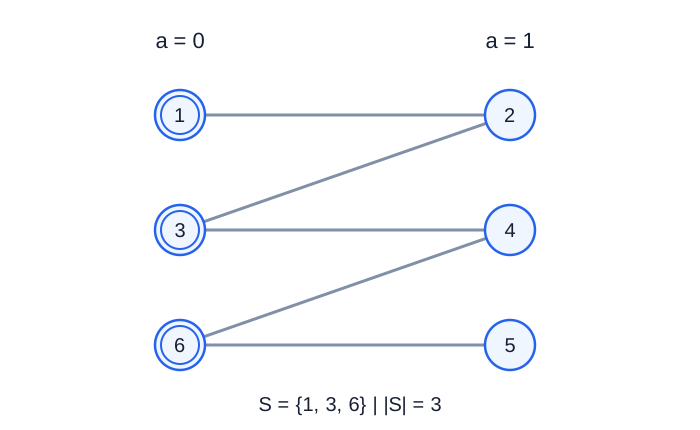
Double circles mark installed connectors. Workbenches are on the left and computers on the right.
In sample 2, the star center, port \(1\) , suffices. In sample 3, computer port \(3\) suffices; isolated port \(4\) needs no connector.
Constraints and Guarantees
For all test cases: \(1\le n\le100000\) , \(1\le m\le200000\) , \(a_i\in\{0,1\}\) , and \(1\le u,v\le n\) . Every cable satisfies \(a_u\ne a_v\) . Isolated ports and parallel cables are allowed.
| Score | Additional restrictions |
|---|---|
| 100% | None |