Didu Hia's Signifier Cycles
Estimated time limit: 0.5 seconds. Memory limit: 128 MB.
The deployed limit is twice the largest per-input median runtime of the reference program on the target judge, rounded up to a multiple of \(0.5\) seconds. See the reference measurements.
Story
“Little bro! How are you supposed to eat like that?”
There are \(n\) Didu Hia, numbered \(1,\ldots,n\) . Each Didu Hia points to exactly one Didu Hia. Following these pointers may lead around a cycle.
Count all the Didu Hia that lie on cycles, counting each one only once.
Formal Problem Statement
There are \(n\) vertices labeled \(1,\ldots,n\) . Every vertex \(i\) has exactly one outgoing edge, pointing to \(d_i\) .
A cycle consists of distinct vertices \(v_1,\ldots,v_k\) with \(d_{v_i}=v_{i+1}\) for \(1\le i<k\) , and \(d_{v_k}=v_1\) . The case \(k=1\) is allowed and is a self-loop.
Count the vertices that lie on at least one cycle, counting each vertex once. A vertex that can reach a cycle but does not itself belong to one is excluded. The answer is zero when \(n=0\) .
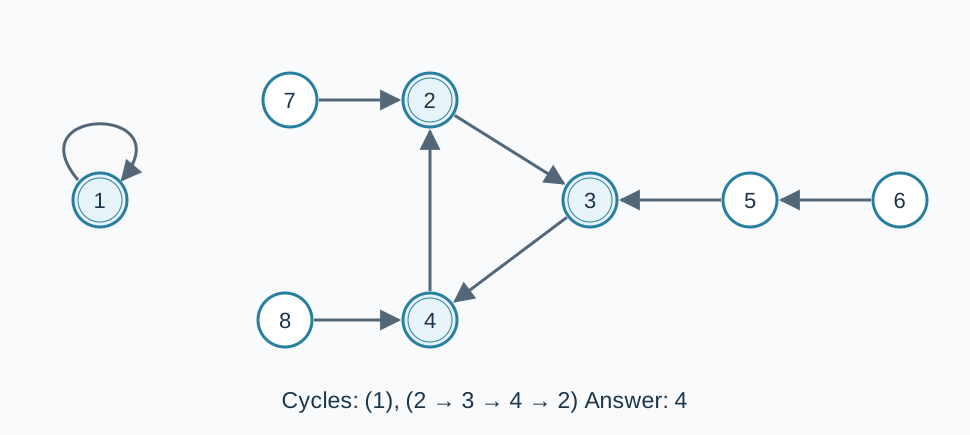
The double circles mark exactly the cycle vertices.
Input
The first line contains \(n\) . The next \(n\) lines contain one integer each; line \(i\) gives \(d_i\) .
Output
Print one integer: the total number of cycle vertices.
Samples
Sample 1
Input
8
1
3
4
2
3
5
2
4
Output
4
Sample 2
Input
4
1
2
3
4
Output
4
Sample 3
Input
0
Output
0
Sample explanations
Sample 1 has the self-loop \(1\to1\) and cycle \(2\to3\to4\to2\) , containing \(4\) vertices in total. The remaining vertices only lead into a cycle. Every vertex in Sample 2 has a self-loop. Sample 3 is empty.
Constraints and guarantees
For all inputs: \(0\le n\le10^5\) ; for every existing vertex, \(1\le d_i\le n\) .
| Score | Additional conditions |
|---|---|
| 100% | No additional conditions |