Completing Dial Relations
Estimated time limit: 0.5 seconds. Memory limit: 128 MB.
The actual time limit is twice the slowest-case median runtime of the reference solution on the target judge, rounded up to a multiple of \(0.5\) seconds. See the benchmark environment.
Story
A dial device uses numbers to represent elements, and several numbers may name the same element. Some directed relations have already been recorded. The device wants to complete them into a lattice without introducing forbidden reversals of existing relations.
Formal Problem Statement
A partial order \(\le\) is reflexive, antisymmetric, and transitive: \(x\le x\) ; if \(x\le y\) and \(y\le x\) , then \(x=y\) ; if \(x\le y\) and \(y\le z\) , then \(x\le z\) .
An upper bound \(u\) of \(x,y\) satisfies \(x\le u\) and \(y\le u\) . An upper bound that is at most every other upper bound is their least upper bound, or join. Lower bounds and the greatest lower bound, or meet, reverse these comparisons. A nonempty partially ordered set is a lattice if every pair has both a join and a meet.
Symbols are different from elements: several symbols may represent the same element. Let \(f\) map each symbol to one element, with every element represented by at least one symbol. A symbol relation represents the partial order when a relation between symbols \(i,j\) exists exactly when \(f(i)\le f(j)\) . The element set and the mapping \(f\) may be chosen; they are not supplied as input.
There are \(N\) symbols numbered \(1,\ldots,N\) . The input gives one symbol \(a_i\) for each symbol \(i\) , defining
Determine whether relations can be added to obtain \(R'\supseteq R\) that represents a lattice and satisfies this restriction: for every initial relation \((i,j)\in R\) , its reverse \((j,i)\) cannot be newly added. A reverse already present in \(R\) may remain. Formally, \((j,i)\notin R'\setminus R\) is required.
Only decide whether a completion exists; do not output the mapping or the completed relation.
Input Format
The first line contains the test-case count \(T\) . Each case starts with \(N\) , followed by \(N\) lines. The \(i\)-th such line contains \(a_i\) , representing the initial relation \((i,a_i)\) .
Output Format
For each test case, print Y if a valid completion exists, or N otherwise, on its own line.
Samples
Sample 1
Input
4
2
2
1
3
2
1
3
3
2
3
1
3
1
2
3
Output
Y
Y
N
Y
Sample 2
Input
3
1
1
5
2
3
4
5
5
4
2
3
4
2
Output
Y
Y
N
Sample Explanation
In the first sample, the two opposite relations between symbols one and two already exist, so they may represent one element. A directed cycle of three symbols cannot be completed legally, giving N for the third case in that input. When every symbol only relates to itself, extra relations can order the elements in a chain, which is a lattice.
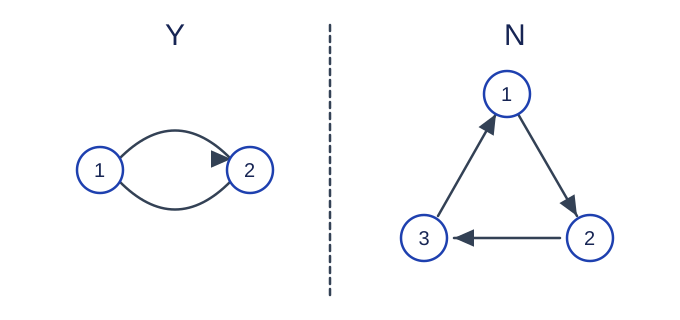
Arrows are initial relations; the left and right diagrams give Y and N , respectively. The second sample also covers one symbol, a chain, and a three-cycle with an attached chain.
Constraints and Guarantees
Each test case satisfies \(1\le N\le2\times10^5\) and \(1\le a_i\le N\) . The sum of \(N\) over the input file is at most \(4\times10^5\) . Self-loops and multiple symbols representing one element are allowed.
| Score share | Additional conditions |
|---|---|
| 100% | None |