Starts and Destinations
Estimated time limit: 1.5 seconds. Memory limit: 128 MB.
The actual time limit is twice the slowest-case median runtime of the reference solution on the target judge, rounded up to a multiple of \(0.5\) seconds. See the benchmark environment.
Story
A transport network has several possible departure stations and several receiving stations. Choose one of each and find the minimum total travel cost.
(This story was rewritten by GPT-6.)
Formal Problem Statement
An undirected graph has \(n\) vertices numbered \(1,\ldots,n\) and \(m\) edges with nonnegative weights. Labels define two disjoint sets: vertex \(i\) belongs to the source set \(S\) if \(b_i=0\) , to the destination set \(T\) if \(b_i=1\) , and to neither if \(b_i=2\) .
Choose any source in \(S\) and any destination in \(T\) . Find the minimum sum of edge weights among all paths with such endpoints. If no such path exists, including when either set is empty, output \(-1\) . Parallel edges, self-loops, and zero-weight edges are allowed.
Input Format
The first line contains \(n,m\) . The second contains \(b_1,\ldots,b_n\) . Each of the next \(m\) lines contains \(u,v,c\) , describing an undirected edge of weight \(c\) between vertices \(u\) and \(v\) .
Output Format
Print one integer: the minimum path weight, or \(-1\) if no eligible path exists.
Samples
Sample 1
Input
5 5
0 2 1 0 1
1 2 5
2 3 2
4 2 1
4 5 9
1 5 20
Output
3
Sample 2
Input
3 2
0 2 1
1 2 0
1 1 5
Output
-1
Sample 3
Input
2 1
0 1
1 2 0
Output
0
Sample Explanation
In the first sample, choose source \(4\) and destination \(3\) . The path \(4\to2\to3\) costs \(1+2=3\) . In the second, destination \(3\) cannot be reached. The third has a zero-weight edge between a source and a destination, so its answer is zero.
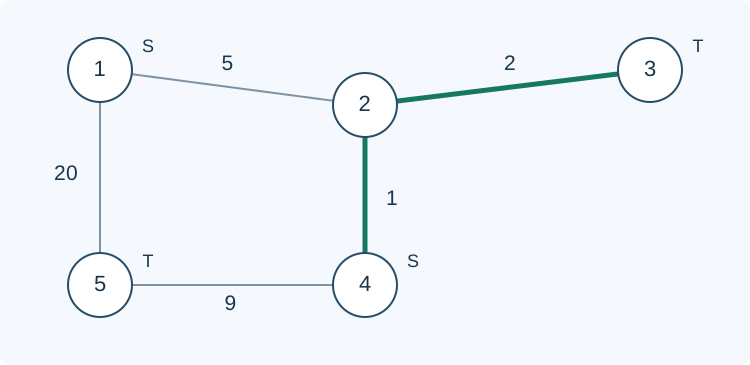
Letters \(S,T\) mark set membership, and edge labels are weights. The two emphasized edges form an optimal path.
Constraints and Guarantees
For all inputs, \(1\le n,m\le5\times10^5\) , \(b_i\in\{0,1,2\}\) , \(1\le u,v\le n\) , and \(0\le c\le10^9\) . Either set may be empty, and the graph need not be connected.
| Score share | Additional conditions |
|---|---|
| 40% | \(n\le500\) and \(\lvert S\rvert,\lvert T\rvert\le1\) |
| 20% | \(\lvert S\rvert,\lvert T\rvert\le1\) |
| 40% | None |