Editorial for Grox's Sequence VII
Problem setter’s solution: a Vandermonde determinant, roots-of-unity evaluation, and NTT. Codex (GPT-6) repairs the bit-reversal permutation and twiddle-factor implementation, normalizes residues, and handles the one-by-one matrix. The algorithm and principal modeling follow the setter’s method.
Replacing the determinant by a product
Let \(N=2^k\) . Column \(i\) consists of \(1,A_i,A_i^2,\ldots,A_i^{N-1}\) , giving a Vandermonde matrix over a polynomial ring. Its determinant is
The identity holds in every commutative ring. First regard the \(A_i\) as independent variables. Swapping columns changes the determinant’s sign, and equal variables make it zero, so every difference is a factor. The determinant and the product have the same total degree. Comparing the coefficient of \(A_2A_3^2\cdots A_N^{N-1}\) makes the proportionality constant \(1\) . Substitution of polynomials preserves the identity.
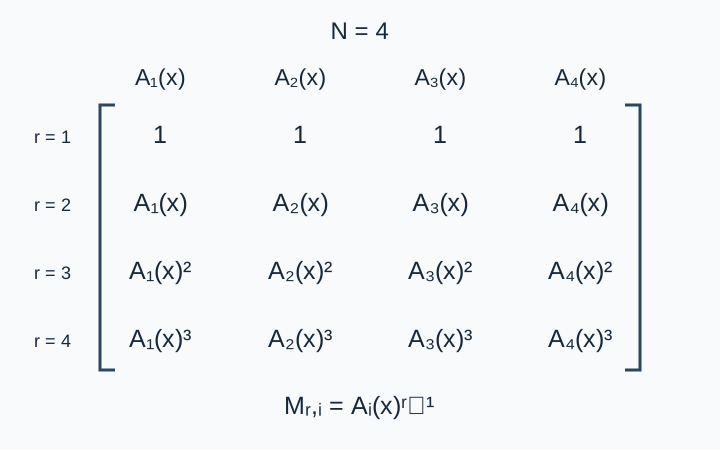
The figure shows \(N=4\) . One input row describes one polynomial, while its successive powers form a matrix column.
Folding exponents and evaluating roots of unity
The output is the remainder of \(B(x)\) modulo \(x^N-1\) : since \(x^N\equiv1\) , every exponent folds into its residue modulo \(N\) . The potentially high-degree determinant need not be expanded.
The prime modulus is \(P=1004535809=479\times2^{21}+1\) , with primitive root \(3\) . Set
The values \(1,\omega,\ldots,\omega^{N-1}\) are \(N\) distinct roots of unity. Apply a length-\(N\) NTT to every input polynomial, obtaining values at all these roots. At each root compute
Finally, inverse-transform these values to recover the remainder coefficients of degree less than \(N\) .
Correctness and implementation details
The Vandermonde identity expresses the determinant exactly as the product of differences. At a root of unity, \(x^N-1\) vanishes, so the original polynomial and its remainder agree. The length-\(N\) NTT is invertible and uniquely recovers the required remainder. For \(N=1\) , the difference product is empty and equals the constant \(1\) , matching the one-by-one matrix.
Bit reversal compares indices \(i<j\) , never the values stored at those positions. Generate each layer’s twiddle factors by successive multiplication by the corresponding root. The inverse uses inverse roots and multiplies by the inverse of \(N\) . Normalize negative differences before multiplication.
Complexity
The \(N\) input transforms take \(O(N^2\log N)\) time. Each root needs \(\binom N2\) differences, totaling \(O(N^3)\) multiplications. The inverse transform takes \(O(N\log N)\) . Total time is \(O(N^3+N^2\log N)\) and space is \(O(N^2)\) . Direct multiplication in the coefficient domain is also correct, but each naive cyclic convolution costs \(O(N^2)\) , for \(O(N^4)\) total time; it is useful for independent small-instance validation.
Supplementary solution
Ordered divide and conquer, product trees and multipoint evaluation compute the difference products in \(O(N^2(1+\log N)^3)\) total time, with lower asymptotic growth than pairwise multiplication. Small transforms and divisions have larger constants: it is slower for the measured \(N\le512\) inputs, but meets their 1.0-second limit. It is a parallel algorithm with an asymptotic advantage; pairwise multiplication remains the reference.