A Certain Unscientific Polynomial-Weighted Geometric Sum with Updates
Story
While working through the paper for Academy City's Zeroth High School Mock Exam, Xiao A came across an interesting mathematics problem and decided to use his knowledge of algorithms to expand its input bounds.
Formal Problem Statement
Let \(P=10^9+7\) . Given a fixed base \(a\) and coefficients \(b_0,\ldots,b_k\) , maintain
Print the initial value, then process \(m\) operations in order and print the value after each:
1 n: replace the upper summation bound with the new \(n\) .2 j b: replace coefficient \(b_j\) with \(b\) .
The base \(a\) and maximum allowed degree \(k\) remain fixed. Coefficients may be zero. Every exponent \(i\) is positive, so \(a=0\) gives zero weight for every term; \(i^0=1\) . Print nonnegative residues modulo \(P\) .
Input Format
The first line contains n m k a . The second gives \(k+1\) coefficients \(b_0,\ldots,b_k\) . The next \(m\) lines contain operations in the formats above.
Output Format
Print \(m+1\) lines: the initial value, then the value after each update.
Sample 1
Input
3 3 1 2
1 1
1 2
2 0 0
1 1
Output
48
16
10
2
Sample 2
Input
3 2 2 1
0 0 1
1 4
2 2 0
Output
14
30
0
Sample 3
Input
1000000000 2 1 0
1000000006 1000000006
1 1
2 0 7
Output
0
0
0
Sample Explanation
In sample 1, the initial value is \(2(1+1)+4(1+2)+8(1+3)=48\) . Changing the bound to 2 gives 16, setting the constant term to zero gives 10, and finally setting the bound to 1 gives 2. Sample 2 is a sum of squares; sample 3 has zero base.
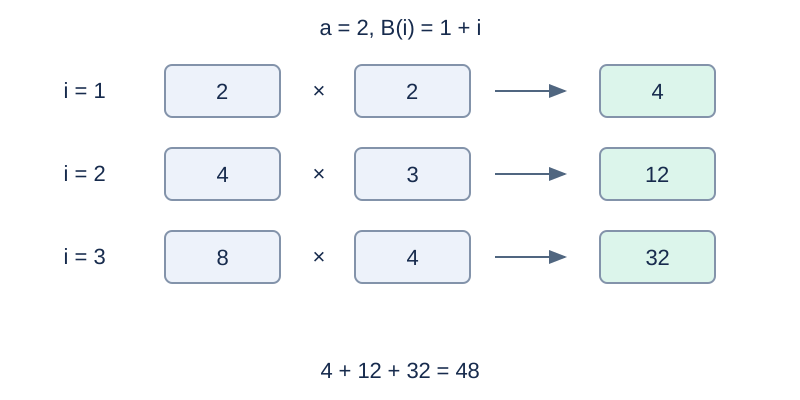
The three weighted polynomial terms in sample 1 sum to 48.
Constraints and Scoring
Initially and after updates, \(1\le n\le10^9\) ; \(1\le m\le10000\) , \(1\le k\le200\) , \(0\le a,b_j,b<P\) , and coefficient indices satisfy \(0\le j\le k\) .
Specifications redesigned by Codex (GPT-6): the fixed base input, coefficient bounds, update indices, and the initial output.
| Score | Additional constraints |
|---|---|
| 20% | \(k\le4,\ m\le30\) , and every \(n\le20\) |
| 30% | \(k\le30,\ m\le300\) , and every \(n\le1000\) |
| 50% | No additional constraints |
Resource Limits
Time: 0.5 seconds. Memory: 128 MiB. The limit is twice the slowest standard-program median over five runs per input, rounded up to 0.5 seconds.