Permuting Grilled Cuttlefish
Estimated time limit: 0.5 seconds. Memory limit: 128 MB.
The actual time limit is twice the slowest-case median runtime of the reference solution on the target judge, rounded up to a multiple of \(0.5\) seconds. See the benchmark environment.
Story
A cook repeatedly rearranges a row of distinct grilled cuttlefish using the same rule. He wants the fewest positive number of rearrangements that restores the original order.
Formal Problem Statement
You are given a permutation \(a\) of \(1,\ldots,N\) . One operation on any permutation \(b\) produces \(b'\) satisfying
Thus the element at position \(i\) moves to position \(a_i\) . Repeat the operation using the same \(a\) . Find the smallest positive number of operations that restores the initial permutation, and output this number modulo \(998244353\) . Since all elements are distinct, the answer does not depend on the particular initial order \(b\) .
Input Format
The first line contains \(N\) . The second contains \(a_1,\ldots,a_N\) . There is exactly one test case.
Output Format
Print the smallest positive operation count modulo \(998244353\) on one line.
Samples
Sample 1
Input
5
2 1 4 5 3
Output
6
Sample 2
Input
1
1
Output
1
Sample 3
Input
6
2 3 4 1 6 5
Output
4
Sample Explanation
In the first sample, positions \(1,2\) return every two operations and positions \(3,4,5\) every three. The first simultaneous return is after six operations. The second sample never changes, but the required count is positive, so its answer is one.
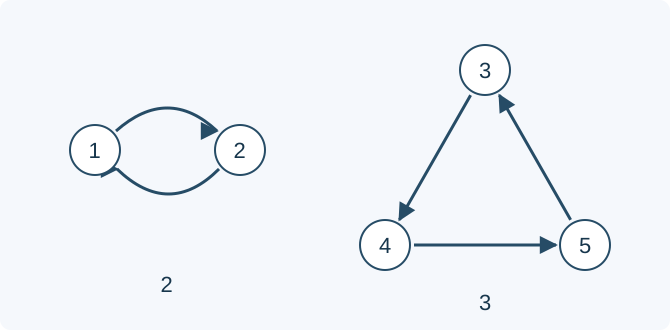
Arrows show the movement in one operation; numbers below the cycles are their lengths. In the third sample, the cycle lengths are four and two, so four operations restore both.
Constraints and Guarantees
For all inputs, \(1\le N\le10^6\) , and \(a\) is a permutation of \(1,\ldots,N\) .
| Score share | Additional conditions |
|---|---|
| 100% | None |