Calculator with Short-Circuit Evaluation
Story
An automated factory evaluates control expressions containing conditions. A calculation in an unselected branch must not make the whole instruction fail, so the calculator must follow short-circuit rules precisely.
Formal Problem Statement
Evaluate one syntactically valid expression. Literals are nonnegative decimal integers from \(0\) to \(10^9\) . Leading zeros are allowed and still denote decimal values. Spaces and tabs may separate tokens. Parentheses change grouping. There are no increment or decrement operators. Precedence decreases down the table; operators in the same row have equal precedence.
| Operators | Meaning | Associativity |
|---|---|---|
Unary + - ! ~ |
Positive, negative, logical NOT, bitwise NOT | Right |
* / % |
Multiplication, division, remainder | Left |
Binary + - |
Addition, subtraction | Left |
<< >> |
Left shift, right shift | Left |
< > <= >= |
Signed comparisons | Left |
== != |
Equal, unequal | Left |
& |
Bitwise AND | Left |
^ |
Bitwise XOR | Left |
\| |
Bitwise OR | Left |
&& |
Logical AND | Left |
\|\| |
Logical OR | Left |
? : |
Conditional selection | Left |
Use these exact rules:
- Values are signed 32-bit two's-complement integers. Addition, subtraction, multiplication, negation, and left shifts retain the low 32 bits. Bitwise operations use these bits.
- Division truncates toward zero; remainders satisfy \(a=(a/b)b+a\%b\) . As a special case, the minimum integer divided by \(-1\) remains the minimum integer, and its remainder modulo \(-1\) is \(0\) .
- The shift count is the low five bits of the right operand, from \(0\) through \(31\) . Right shifts fill with the sign bit.
- Zero is false and every other value is true. Comparisons and logical operators return \(0\) or \(1\) .
a&&bdoes not evaluatebwhenais false.a||bdoes not evaluatebwhenais true.a?b:cevaluates only the selected branch.- The middle conditional branch is a full expression; the final branch excludes an unparenthesized conditional. The precise grammar is
Conditional := LogicalOr ('?' Expression ':' LogicalOr)*. Thus1?0:1?2:3means(1?0:1)?2:3and evaluates to \(3\) . - Division or remainder by zero makes the entire expression fail only if that operation is actually required. Print
Segmentfaulton failure. An error in a condition also propagates. There are no other runtime errors.
Input Format
Input one expression on one line. The line ending is not part of the expression.
Output Format
Print one line: the signed decimal result, or Segmentfault .
Sample 1
Input
1?0:1?2:3
Output
3
Sample 2
Input
0 && (1 / 0)
Output
0
Sample 3
Input
(1/0) || 1
Output
Segmentfault
Sample 4
Input
15 << 33
Output
30
Sample 5
Input
(1 << 31) / -1
Output
-2147483648
Sample Explanation
The samples demonstrate left-associative conditionals, an ignored branch error, an error in a condition, a shift count reduced to five bits, and division of the minimum integer by −1.
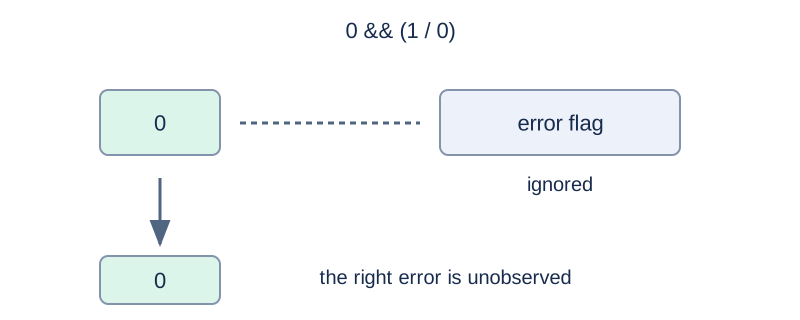
When the left operand of logical AND is zero, division by zero on the right does not fail the expression.
Constraints and Scoring
The expression length is \(1\le n\le200000\) , including whitespace. Literals do not exceed \(10^9\) . The expression obeys the grammar above.
Specifications redesigned by Codex (GPT-6): length, integer wrapping, error behavior, and left-associative conditional expressions.
| Score | Additional constraints |
|---|---|
| 20% | \(n\le60\) |
| 30% | \(n\le5000\) |
| 50% | No additional constraints |
Resource Limits
Time: 0.5 seconds. Memory: 128 MiB.
The limit is 2 times the slowest standard-program median across five runs per formal input, rounded up to 0.5 seconds.