Survival on a Grid
Estimated time limit: 0.5 seconds. Memory limit: 128 MB.
The actual time limit is twice the slowest-case median runtime of the reference solution on the target judge, rounded up to a multiple of \(0.5\) seconds. See the benchmark environment.
Story
A roaming robot lands uniformly at random in a grid of roads and pits. It cannot recognize danger and simply steps in a random direction. Find the probability that it remains safe throughout the required number of steps.
(This story was rewritten by GPT-6.)
Formal Problem Statement
You are given a grid with \(n\) rows and \(m\) columns, each cell being a road or a pit. The starting cell is chosen uniformly from all \(nm\) cells, including pits. The robot then takes \(k\) steps. Each step independently chooses up, down, left, or right with equal probability and moves one cell. Staying still is forbidden. A direction leading outside or into a pit is not retried.
A process succeeds exactly when every visited position, including both endpoints, is a road inside the grid. Write its probability as \(p/q\) , where \(p\ge0,q>0\) , and output
Here \(P\) is prime, and \(q^{-1}\) is the multiplicative inverse modulo \(P\) . You may use \(q=nm\cdot4^k\) directly; the constraints ensure that this denominator is coprime to \(P\) .
Input Format
The first line contains \(n,m,k\) . The next \(n\) lines each contain a string of \(m\) characters from 01 , without spaces. Character 0 denotes a pit and 1 a road.
Output Format
Print the success probability modulo \(P\) as one integer between \(0\) and \(P-1\) .
Samples
Sample 1
Input
1 1 0
1
Output
1
Sample 2
Input
2 2 1
11
11
Output
3940649673949185
Sample 3
Input
2 2 1
10
11
Output
5910974510923777
Sample 4
Input
3 3 1
111
011
111
Output
3940649673949185
Sample 5
Input
3 3 3
111
011
111
Output
1067259286694571
Sample 6
Input
1 1 1
1
Output
0
Sample Explanation
The first sample makes no move and its only cell is a road, so the probability is one. In the second, each start has two safe directions, giving one half. In the third, four of the sixteen equally likely start-and-direction choices are safe, giving one quarter. The fourth also has probability one half. The fifth has \(114\) safe three-step processes out of \(9\cdot4^3=576\) , giving \(19/96\) . In the sixth, every move exits the grid, giving zero.
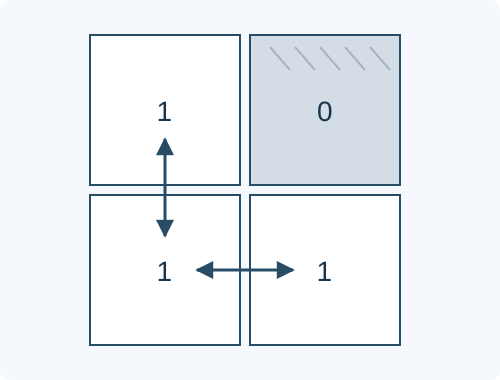
Cell numbers match the input characters. Arrows show successful one-step moves only; each of the other directions still has probability one quarter.
Constraints and Guarantees
For all inputs, \(n,m\ge1\) , \(1\le nm\le10^6\) , and \(0\le k\le25\) . There may be no roads. When \(k=0\) , only the starting cell matters.
| Score share | Additional conditions |
|---|---|
| 100% | None |