Expected Trials for Unique Substring Hits
Time limit: 0.5 seconds. Memory limit: 128 MiB. Recalibrate as twice the slowest standard median in the target environment, rounded up to 0.5 seconds; see the environment.
Story
An archive uses short labels to locate positions in a long record. A randomly chosen label succeeds only if it occurs exactly once. The archivist wants the expected number of trials needed for a requested number of successful lookups.
(This story was rewritten by GPT-6.)
Formal Problem Statement
You are given a string \(S\) of length \(n\) . Each trial independently chooses uniformly among the distinct nonempty contiguous substrings of \(S\) . A substring may be selected again on later trials. Choices are distinct strings, not position intervals.
A trial succeeds exactly when its chosen substring occurs once in \(S\) . Occurrences may overlap. For each query \(N\) , find the expected total number of trials performed when the number of successes first reaches \(N\) . This expectation is zero for \(N=0\) .
Let \(P=1000000007\) . Express the exact expectation as a reduced nonnegative fraction \(A/B\) with \(B>0\) . If \(P\) divides \(B\) , print \(-1\) . Otherwise print the least nonnegative residue \(AB^{-1}\bmod P\) .
Input Format
The first line contains n Q . The second contains the length-\(n\) string \(S\) , whose characters have ASCII codes from 33 through 126. Each of the next \(Q\) lines contains a nonnegative integer \(N\) .
Output Format
For each query, print its residue or \(-1\) under the reduced-fraction rule above.
Sample 1
Input
5 3
ababa
4
1
0
Output
9
250000004
0
Sample 2
Input
4 3
aaaa
1
4
1000000000000000000
Output
4
16
196
Sample 3
Input
3 3
a!a
1
2
4
Output
250000003
500000006
5
Sample Explanation
Sample 1 has 9 distinct substrings. Exactly four occur once: bab , abab , baba , and ababa . The success probability is \(4/9\) , so 4 successes require an expected 9 trials.
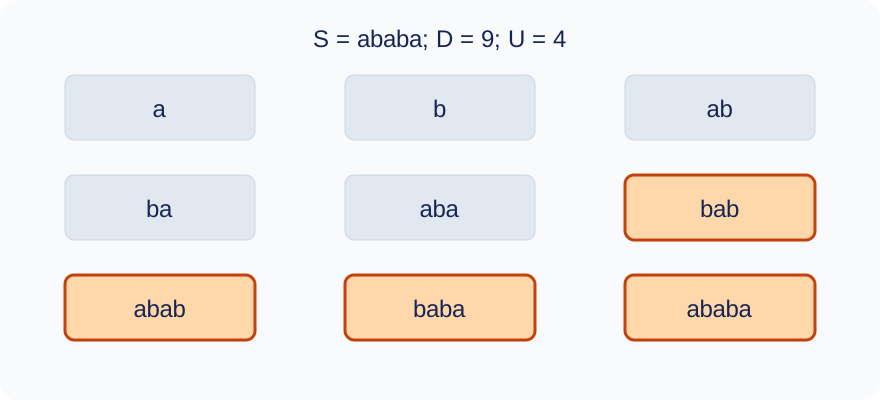
The 9 distinct substrings of ababa ; the 4 boxed strings occur exactly once.
Constraints and Scoring
\(1\le n\le10^5\) , \(1\le Q\le500\) , and \(0\le N\le10^{18}\) . The alphabet consists of all 94 characters with ASCII codes 33 through 126; whitespace is excluded.
Specifications redesigned by Codex (GPT-6): the exact alphabet, independent sampling and stopping-time expectation, and output when the reduced denominator is not invertible.
| Score | Additional constraints |
|---|---|
| 20% | \(n\le20\) |
| 30% | \(n\le2000\) |
| 50% | No additional constraints |
There are 10 tests worth 10% each. See the test recipes.