Block Tower
Estimated time limit: 0.5 seconds. Memory limit: 128 MB.
On the target judge, multiply the reference program's largest per-case median time by \(2\) and round up to a multiple of \(0.5\) seconds. See the reference environment.
Story
A block tower must be transferred between three platforms. Every block has a name, and the mover needs a sequence of printed instructions.
Formal Problem Statement
There are three platforms, referred to as \(A,B,C\) , whose display names are given in the input. Initially all \(n\) blocks are on platform \(A\) , in the supplied bottom-to-top order. The other platforms are empty.
One move takes the top block from one platform and places it on top of another. Whenever block \(Y\) is directly above block \(X\) , \(Y\) must also have been above \(X\) in the initial tower, possibly with other blocks between them.
Move every block to platform \(B\) using the minimum number of moves, and print the operations. Names are labels; the initial positions determine block order. Names need not be distinct.
Input Format
The first line contains \(n\) .
The next three lines give the display names of platforms \(A,B,C\) . The following \(n\) lines give the block names in initial bottom-to-top order.
Each name occupies a complete line of \(1\) to \(20\) English letters, digits, ASCII spaces or underscores. Leading, internal and trailing spaces are part of the name and must be preserved. The line ending is not part of the name.
Output Format
Print one line per move, using exactly this format:
Move <block> from <source> to <target>.
Replace <block> , <source> and <target> with the complete block, source-platform and target-platform names. Do not print angle brackets. Preserve the other letters, spaces and final period from the template. Do not print a separate move count.
Examples
Example 1
Input
2
226 A AA ____ 1026
CC
BB
1
2_
Output
Move 2_ from 226 A AA ____ 1026 to BB.
Move 1 from 226 A AA ____ 1026 to CC.
Move 2_ from BB to CC.
Example 2
Input
1
A
B
C
Only
Output
Move Only from A to B.
Example 3
Input
3
Left
Middle
Right
Large block
Mid_block
Small
Output
Move Small from Left to Middle.
Move Mid_block from Left to Right.
Move Small from Middle to Right.
Move Large block from Left to Middle.
Move Small from Right to Left.
Move Mid_block from Right to Middle.
Move Small from Left to Middle.
Example Explanation
In the first example, the three input names correspond to \(A,B,C\) in order. Move the upper block to \(C\) , the lower block to \(B\) , and finally the upper block to \(B\) , taking three moves.
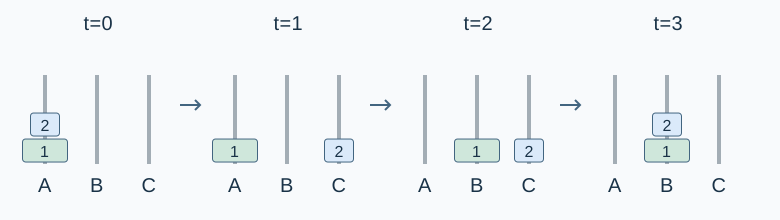
The diagram uses \(A,B,C\) for platform identities and \(1,2\) for initial bottom-to-top block indices. The output uses the supplied names.
Constraints and Guarantees
\(1\le n\le10\) . Each name satisfies \(1\le |S|\le20\) , with the character set and whitespace rules defined in the input format.
| Score | Additional conditions |
|---|---|
| 100% | None |