Garden Click Coefficient: Solution
Algorithm and Attribution
Codex (GPT-6) completed the specification, dominance proof, enumeration, and implementation in std.cpp. The formulas use the stated 20% neighbor boost and add no constant term to click or milk bonuses.
Remove Two Dominated Choices
Fix the N cells and the soil. Each remaining cell has a fixed effect \(F\) with \(0<F\le3.4375\) , so all penalty factors are nonnegative.
Replacing E by B increases production without reducing any other factor. An optimum therefore needs no E cells.
For a D cell, let \(P\ge1\) be the production factor from the other cells. Its production increase and click penalty contribute
Replacing D by E cannot decrease the score; replacing that E by B cannot decrease it either. Neither replacement changes the N neighborhood. Only B, T, W, N, and G remain necessary.
Enumeration
Let \(g=nm\) . Enumerate both soils and every mask of N cells. Count neighboring N cells in all eight directions and calculate each remaining cell's effect. Recursively assign B, T, W, or G to those cells.
Maintain the sums of the effects for B, T, W, and G, together with the product of G production penalties. Evaluate the stated formula at each leaf. Include the empty N mask and the all-N mask; the latter has zero click coefficient.
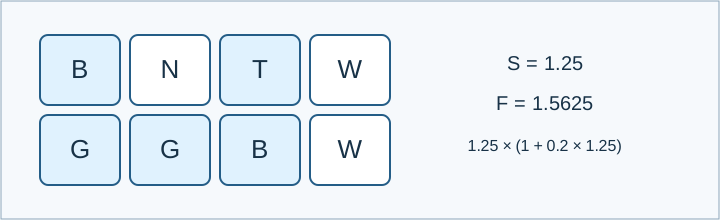
An N cell affects other cells whose row and column differences are both at most one, including diagonal neighbors.
Correctness
The replacements prove that some optimum contains neither E nor D. The enumeration includes its soil, all its N positions, and every remaining plant. The maintained sums and product reproduce the formula exactly in real arithmetic. Taking the maximum therefore gives the global optimum.
Complexity and Numerics
A mask containing \(t\) N cells has \(4^{g-t}\) assignments, so the total is
Time is \(O(g^2 2^g+5^g)\) and auxiliary space is \(O(g)\) . The implementation uses long double and prints scientific notation with 18 digits after the decimal point. Formal answers come from an independent complete-layout enumeration and 60-digit Decimal rescoring. Small boards also compare all seven plant types, including E and D.
See the test documentation for recipes, seeds, and measurements.