Character X
Estimated time limit: 0.5 seconds. Memory limit: 128 MB.
The deployed limit is twice the largest per-input median runtime of the reference program on the target judge, rounded up to a multiple of \(0.5\) seconds. See the reference measurements.
Story
To access a set of practice materials, a student must pass a printing check on a website: draw a fixed-size X using the requested character.
Formal Problem Statement
For each character \(c\) , print a rectangle with \(8\) rows and \(10\) columns. Rows \(i\) run from \(1\) through \(8\) , and columns \(j\) run from \(1\) through \(10\) . Print \(c\) at \((i,j)\) if at least one of the following conditions holds; otherwise print one space:
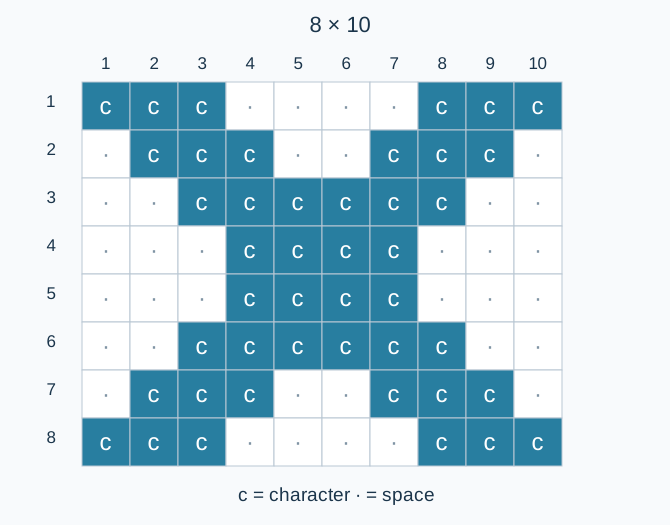
Dots in the diagram only mark space positions; output actual spaces. Where the two strips overlap, print just one character.
Input
The first line contains an integer \(T\) . Each of the next \(T\) lines contains one character \(c\) .
Output
Print \(8\) consecutive rows for each character, each containing exactly \(10\) characters followed by a newline. Preserve leading and trailing spaces, with no blank lines between groups. There are \(8T\) output rows in total; print nothing when \(T=0\) .
Samples
Sample 1
Input
3
A
c
9
Output
AAA    AAA
 AAA  AAA
  AAAAAA
   AAAA
   AAAA
  AAAAAA
 AAA  AAA
AAA    AAA
ccc    ccc
 ccc  ccc
  cccccc
   cccc
   cccc
  cccccc
 ccc  ccc
ccc    ccc
999    999
 999  999
  999999
   9999
   9999
  999999
 999  999
999    999
Sample 2
Input
1
Z
Output
ZZZ    ZZZ
 ZZZ  ZZZ
  ZZZZZZ
   ZZZZ
   ZZZZ
  ZZZZZZ
 ZZZ  ZZZ
ZZZ    ZZZ
Sample 3
Input
0
Output
Sample explanations
Sample 1 draws the same pattern using an uppercase letter, a lowercase letter and a digit. In Sample 2, rows two and seven each end with one space. Sample 3 has no printing tasks and produces empty output.
Constraints and guarantees
For all inputs: \(0\le T\le20\) ; \(c\) is an uppercase English letter, a lowercase English letter or a decimal digit.
| Score | Additional conditions |
|---|---|
| 100% | No additional conditions |