String Functions in Contiguous Memory
Estimated time limit: 0.5 seconds. Memory limit: 128 MB.
The actual limit is twice the slowest per-case median time of the standard program on the target judge, rounded up to a multiple of \(0.5\) seconds. See the evaluation notes.
Story
An old teaching terminal stores several character arrays next to each other. Its maintainer checks each operation: some stay inside their array, some touch a neighboring array, and some must be rejected before execution.
(This story was rewritten by GPT-6.)
Formal Problem Statement
There are \(n\) arrays indexed \(0,\ldots,n-1\) . Array \(i\) has length \(m_i\) , and every element is \(0\) or \(1\) . The arrays occupy consecutive memory in index order, without gaps. Define \(p_0=0\) , \(p_i=\sum_{j<i}m_j\) , and \(S=\sum_i m_i\) . Pointer \((x,y)\) denotes global address \(p_x+y\) . Offset \(y\) may be negative.
Execute the following operations in order, using the memory left by previous successful operations.
0 x y v c: write \(v\) to \(c\) consecutive bytes starting at \((x,y)\) . Printtrueon success.1 x y z w: copy the string starting at \((x,y)\) to \((z,w)\) . A string ends at its first byte equal to \(0\) . The terminating byte is included in the copy. Printtrueon success.2 x y: report the length of the string starting at \((x,y)\) . Read the terminating byte but exclude it from the length.
Validate the whole operation before changing memory, in this priority order:
- If any required read or write address is outside \([0,S)\) , print
overflowand change nothing. A string that reaches the end of memory without a terminator also causes this error. - For a copy, if the source and destination intervals share an address, print
overwriteand change nothing. Both intervals include the terminator. Apply this check only when there is no globally invalid address. - Otherwise, execute normally. If any accessed address is outside the array named by its pointer, prefix the normal result with
w, without a space.
Check source and destination accesses against their own named arrays. Warnings never prefix overflow or overwrite . In particular, a write with \(c=0\) accesses nothing and always prints true , even when its pointer is outside global memory.
Input
The first line contains \(n\) . The second contains the \(n\) lengths \(m_i\) . The next \(n\) lines give the initial arrays: line \(i+1\) contains the \(m_i\) elements of array \(i\) . The next line contains the operation count \(k\) , followed by \(k\) operations in the formats above.
Output
Print one line per operation: a length, true , a normal result prefixed with a warning, or the applicable error string.
Examples
Example 1
Input
2
3 3
1 1 0
1 0 0
5
2 0 0
1 0 0 1 0
2 1 0
0 0 3 0 1
2 1 0
Output
2
true
2
wtrue
0
Example 2
Input
1
3
1 1 0
6
1 0 0 0 1
1 0 0 0 0
0 0 -1000000000 1 0
2 0 0
0 0 2 1 1
2 0 0
Output
overflow
overwrite
true
2
true
overflow
Example 3
Input
3
3 2 4
1 0 1
1 1
1 0 0 1
19
0 2 3 1 1
0 2 4 1 0
0 2 4 1 1
0 1 2 1 1
2 0 1
2 0 0
2 0 1
2 0 3
2 0 5
2 1 -1
2 2 2
2 2 3
2 0 5
1 0 1 2 100
1 0 1 2 0
2 1 1
1 0 2 1 0
2 0 2
1 1 1 2 2
Output
true
true
overflow
wtrue
0
1
0
w3
w1
w4
0
overflow
w1
overflow
true
w1
overwrite
w3
wtrue
Example Explanation
In sample 1, the copy writes 1 1 0 into array 1. A later write reaches its first byte through an out-of-bounds pointer relative to array 0, so it prints wtrue . Sample 2 demonstrates global overflow taking priority over overlap, copying onto itself, and a zero-length write. Sample 3 covers accesses across several arrays and memory state after rejected operations.
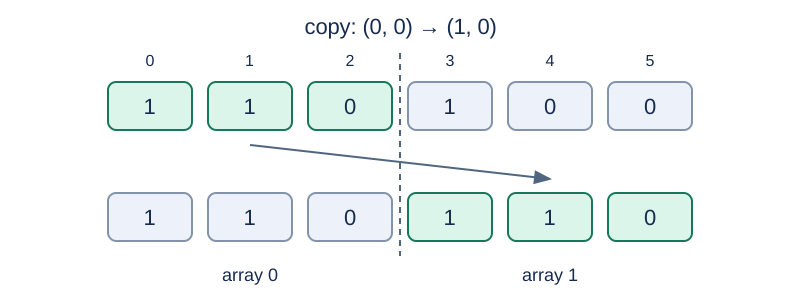
The copy in sample 1. The dashed boundary separates arrays; global addresses remain consecutive.
Constraints and Guarantees
All data satisfy \(1\le n\) , \(1\le m_i\) , \(S\le1000\) , and \(1\le k\le50000\) . All array indices are valid. Every offset has absolute value at most \(10^9\) , \(0\le c\le10^9\) , and initial bytes and write values belong to \(\{0,1\}\) .
Specifications redesigned by Codex (GPT-6): the total size of variable-length arrays, atomic operations, and the priority of boundary checks are explicit.
| Score | Additional conditions |
|---|---|
| 20% | \(S\le20\) , \(k\le100\) |
| 30% | \(S\le100\) , \(k\le1000\) |
| 50% | No additional conditions |