Noncrossing 1212 Subsequences
Indicative time limit: 0.5 seconds. Memory limit: 2048 MiB. Recalibrate as twice the slowest standard median in the target environment, rounded up to 0.5 seconds. See the environment.
Story
A signal operator records two pulse types as 1 and 2 and wants to extract as many 1212 groups as possible. Marks pairing a 1 with its following 2 may nest, but may not cross.
(This story was rewritten by GPT-6.)
Formal Problem Statement
Given a length-\(n\) string \(s\) containing only 1 and 2, choose as many subsequences as possible subject to these rules:
- Each subsequence is exactly 1212: positions \(a<b<c<d\) satisfy \(s_a=s_c=1\) and \(s_b=s_d=2\) .
- No string position is used by two selected subsequences.
- Each subsequence marks two pairs, \((a,b)\) and \((c,d)\) . Two marked pairs from different subsequences must not cross: endpoint orders \(u<x<v<y\) and \(x<u<y<v\) are forbidden.
Pairs may nest or be disjoint. Rule 3 checks only the adjacent 1-to-2 pairs, not the middle 2-to-1 connection. Characters may be left unused. The empty string has answer zero.
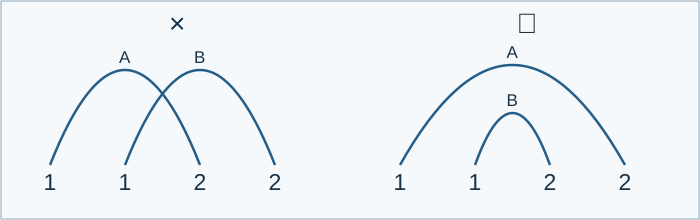
The figure shows only two 1-to-2 pairs. The crossing on the left is forbidden; the nesting on the right is allowed. These pairs do not by themselves depict complete 1212 subsequences.
Input Format
The first line contains \(n\) , and the second contains \(s\) . For \(n=0\) , the second line is empty.
Output Format
Print the maximum number of selected subsequences.
Sample 1
Input
16
1121122121222111
Output
2
Sample 2
Input
20
11221122111112222122
Output
5
Sample 3
Input
0
Output
0
Sample 4
Input
4
1122
Output
0
Constraints and Scoring
\(0\le n\le10^7\) . The string contains only 1 and 2.
| Score | Additional constraints |
|---|---|
| 100% | None |
There are ten formal files worth 10% each.
See the test recipes.