Paper Tiger Sequence
Estimated time limit: 0.5 seconds. Memory limit: 16 MB.
On the target judge, multiply the reference program's largest per-case median time by \(2\) and round up to a multiple of \(0.5\) seconds. See the reference environment.
Story
An archivist extends a “paper tiger” strip by copying a short cyclic segment of its current text to the front. Recover several historical versions by their version numbers.
(This story was rewritten by GPT-6.)
Formal Problem Statement
The initial string is \(S_0\) . Perform \(N\) growth operations. Operation \(i\) uses parameter \(p_i\) to construct \(S_i\) from \(S_{i-1}\) . String indices start at \(0\) .
Let the current length be \(L=|S_{i-1}|\) . The added length is
Copy \(S_{i-1}[(p_i+k)\bmod L]\) in order for \(k=0,1,\ldots,D-1\) , forming \(T_i\) . Set
Here \(+\) denotes concatenation. Every copied character comes from the string before growth, wrapping to its beginning after the last character.
Given \(M\) pairwise distinct version numbers, print the corresponding strings in query order.
Input Format
The first line contains the nonempty string \(S_0\) , consisting of English letters and digits. Letters are case-sensitive.
The second line contains \(N,M\) . The next \(N\) lines contain \(p_1,\ldots,p_N\) in order. Each of the following \(M\) lines contains a version number \(q\) .
Output Format
Print \(M\) lines, each containing the complete string \(S_q\) requested by that query. For \(M=0\) , print nothing.
Examples
Example 1
Input
0123456789
5 6
8
10
12
14
15
5
4
3
2
1
0
Output
345676789789898890123456789
6789789898890123456789
789898890123456789
898890123456789
890123456789
0123456789
Example 2
Input
A
0 1
0
Output
A
Example 3
Input
abcde
2 3
4
5
2
0
1
Output
eeeabcde
abcde
eabcde
Example Explanation
The first example requests all six versions in decreasing order. The second example performs no growth.
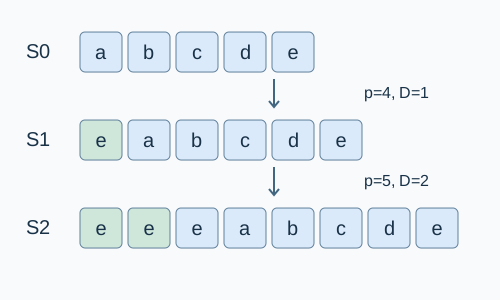
In the third example, the first operation copies one character e from index \(4\) , producing eabcde . The second operation copies two characters cyclically from index \(5\) , obtaining ee , so the new string is eeeabcde .
Constraints and Guarantees
\(1\le |S_0|\le10\) , \(0\le N\le70\) , and \(0\le p_i\le10^9\) .
\(0\le M\le N+1\) . Every queried version satisfies \(0\le q\le N\) , and query indices are pairwise distinct.
| Score | Additional conditions |
|---|---|
| 100% | None |