Arranging Diamond Hangers: Solution
Methods and contributions
The setter visits a hanger, then its lower subtree, then its right subtree, collecting identifiers by level. Codex (GPT-6) uses an explicit stack to avoid deep recursion and retains this order in std.cpp. A horizontal-chain traversal in alternative.cpp, with its editorial, streams completed rows instead of storing every output row. Both are linear and pass the full constraints; choose based on whether rows must remain available afterwards.
Why the lower subtree comes first
At level \(h\) , let the horizontal half-diagonal be \(H=B^{-h}\) . A right child is \(2H\) to the right. Within the lower subtree, a path can move horizontally only at lower levels, with each movement at most \(2H/B\) . A path has fewer than \(n\) edges, so its total displacement is less than \(2nH/B<2H\) .
At any common target level, every hanger in the lower subtree is therefore strictly left of every hanger in the right subtree. The same argument holds recursively inside each subtree. A hanger itself is left of all its descendants on the same row. Thus visiting current, lower, right and retaining only one level gives that row's horizontal order. For two hangers in different branches, apply this argument at their lowest common ancestor. A same-level ancestor relationship uses only right edges and also preserves order.
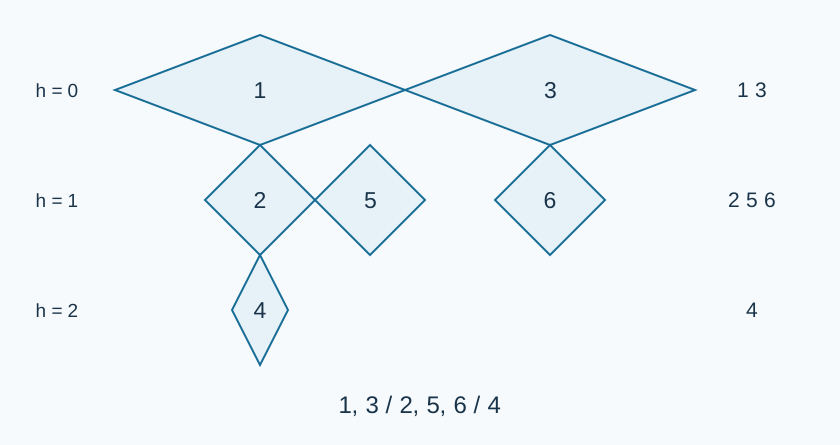
Reference: explicit depth-first traversal
Mark all nonzero children. The unique unmarked hanger is the root. Store pairs of hanger and level on a stack. On removal, append the identifier to its row; push its right child at the same level, then its lower child at the next level. Stack order visits the lower child first. Track the maximum level and finally print rows in increasing level order.
The valid connected tree visits each hanger exactly once. Geometric separation proves each row's ordering, and increasing levels give top-to-bottom order. Lower edges never skip a level, so every level through the maximum is nonempty.
Complexity and implementation
Time and space are \(O(n)\) , including the input tree, traversal stack and stored output rows. Neither exponentially scaled coordinates nor floating-point arithmetic is needed; integer levels suffice.
The row-based method scans each row's horizontal chains and appends lower children to the next-row queue. It is also linear. The input tree uses \(O(n)\) memory, while additional row queues require only \(O(w)\) , where \(w\) is the maximum row width. Depth-first collection is convenient if arbitrary completed rows must be revisited. Do not sort by identifier or assume that hanger one is the root.
Data generation and validation
Run the Python 3 standard-library script tests/generate.py --out-dir <directory> to generate inputs from plan.json. Repeat --case to select identifiers; pass --std <executable> to generate outputs as well. Compile the desired source as C++17 first. Fixed recipes and seeds reproduce the inputs. Store large generated data outside the problem directory.
Measurements record input and source hashes, five timings per case, and peak working set. All delivered variants pass the full test set. 320 small inputs construct exact geometric coordinates with arbitrary-precision integers, then sort by level and coordinate. Every official input compares both traversal methods.