Dynamic Directory Tree
- Indicative time limit: 1.5 seconds (environment and measurements).
- Actual limit: measure the reference solution on the target system, take the largest median time over test files, multiply by 2, and round up to a multiple of 0.5 seconds.
- Memory limit: 512 MB.
Story
A computer shop is building an editable directory index. Connections between directories have weights. A technician may move a whole subtree, change the root from which the tree is viewed, or update a connection. A query asks about the initial path shared by routes from the current root to several directories.
(This story was rewritten by GPT-6.)
Formal Problem Statement
You are given an undirected weighted tree with \(n\) vertices numbered \(1,\ldots,n\) . Its initial root is vertex \(1\) . Edge weights may be negative.
Process the following operations in order. Every parent-child relation and subtree is defined using the current root immediately before the operation.
1 a b v: move the entire subtree rooted at \(a\) below \(b\) . If \(b\) belongs to that subtree, including when \(a=b\) , ignore the operation. Otherwise remove the edge from \(a\) to its parent and add the edge \(a,b\) with weight \(v\) . The current root does not change.2 a: set the current root to \(a\) , leaving all undirected edges and their weights unchanged.3 a b v: if an edge directly connects \(a,b\) , change its weight to \(v\) ; otherwise ignore the operation.4 k a1 a2 ... ak: consider the simple paths from the current root to these \(k\) vertices. Their intersection is an initial path from the root. Output the sum of edge weights on this common path.
If the common path consists only of the root vertex, its sum is \(0\) . An answer may otherwise be negative. The subtree rooted at the current root is the entire tree, so operation 1 on that root is always ignored.
Input Format
The first line contains \(n,m\) , the number of vertices and operations.
Each of the next \(n-1\) lines contains \(a,b,v\) , describing an undirected edge and its weight.
Each of the next \(m\) lines contains an operation in the format above.
Output Format
For each operation 4, output one integer on its own line, in query order. If there are no queries, output nothing.
Sample 1
Input
7 16
1 2 2
2 3 5
2 4 6
3 5 1
3 6 3
4 7 -5
4 1 5
4 1 6
4 1 2
4 1 7
4 2 5 6
4 3 6 3 7
1 4 6 6
4 1 7
4 3 6 5 7
3 4 5 1
3 4 7 1
4 1 7
2 7
4 1 1
4 1 5
4 2 5 1
Output
8
10
2
3
7
2
11
7
17
17
11
10
Sample 2
Input
3 8
1 2 -4
2 3 1
4 2 2 3
1 1 3 9
1 2 3 8
3 1 3 9
2 3
4 2 1 2
1 1 3 7
4 2 1 2
Output
-4
1
0
Sample 3
Input
2 0
1 2 0
Output
Sample Explanation
The first two-vertex query in sample 1 asks about vertices \(5,6\) . Both paths contain \(1\to2\to3\) , whose edge-weight sum is \(2+5=7\) .
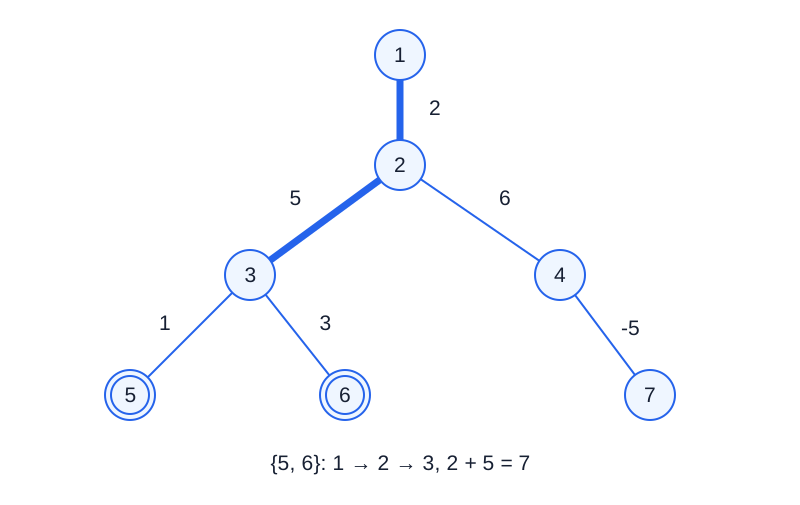
Thick lines mark the common path; numbers beside edges are their weights.
The answers in sample 2 are \(-4,1,0\) . Two attempts to move a subtree inside itself and one update to a nonexistent edge are ignored. Sample 3 has no operations, so its output is empty.
Constraints and Guarantees
For all test cases: \(2\le n\le200000\) , \(0\le m\le200000\) , and every initial or assigned edge weight satisfies \(|v|\le10000\) . Every vertex identifier lies in \(1,\ldots,n\) , and the initial edges form a tree.
Each query has \(1\le k\le200000\) distinct vertices. The sum of \(k\) over all queries is at most \(200000\) .
| Score share | Additional conditions |
|---|---|
| 100% | None |