Grinder
- Indicative time limit: 2.5 s (environment and measurements).
- Deployment time limit: measure the reference program in the target environment, multiply the slowest case's median time by 2, and round up to the next 0.5 seconds.
- Memory limit: 256 MB.
Story
“Who wants to play?”
The Grinder was originally designed to clear roads. It is still used to clear roads.
The map is a tree, and every vertex has a cleanup value. Some locations cost more to clear than they earn, so their values are negative. To speed up its work, the Grinder activates its turbocharger. A trip must cover at least \(L\) roads to make that power worthwhile, but the limited fuel supply allows at most \(R\) roads.
Any vertex may have an emergency that requires immediate cleanup. For each vertex, find the maximum total value of a path that visits it and satisfies the road-count limits.
Formal Problem Statement
You are given an undirected tree with \(n\) vertices numbered \(1,\ldots,n\) . Vertex \(i\) has weight \(v_i\) .
A trip is a simple path, with no repeated vertex, whose number of edges is between \(L\) and \(R\) , inclusive. Its value is the sum of all vertex weights on the path, including both endpoints and counting each vertex once. A trip may start anywhere and travel in either direction.
For every vertex \(i\) , independently find the maximum value of a valid path containing \(i\) . When \(L=0\) , a path consisting of a single vertex may be valid.
Input Format
The first line contains \(n,L,R\) .
The second line contains \(n\) integers \(v_1,\ldots,v_n\) .
Each of the next \(n-1\) lines contains two integers \(u,v\) , describing an undirected edge.
Output Format
Print \(n\) lines. Line \(i\) contains the answer for vertex \(i\) , or -1061109568 if no valid path contains it. A valid path may have a negative value.
Sample 1
Input
5 2 4
-338 971 -35 -221 458
1 2
3 1
3 4
2 5
Output
1091
1091
1056
835
1091
Sample 2
Input
1 0 0
-7
Output
-7
Sample 3
Input
4 3 3
2 -1 4 3
1 2
1 3
1 4
Output
-1061109568
-1061109568
-1061109568
-1061109568
Sample Explanation
In sample 1, path \(1\to2\to5\) has two edges and value \(1091\) ; path \(3\to1\to2\to5\) has three edges and value \(1056\) ; path \(4\to3\to1\to2\to5\) has four edges and value \(835\) .
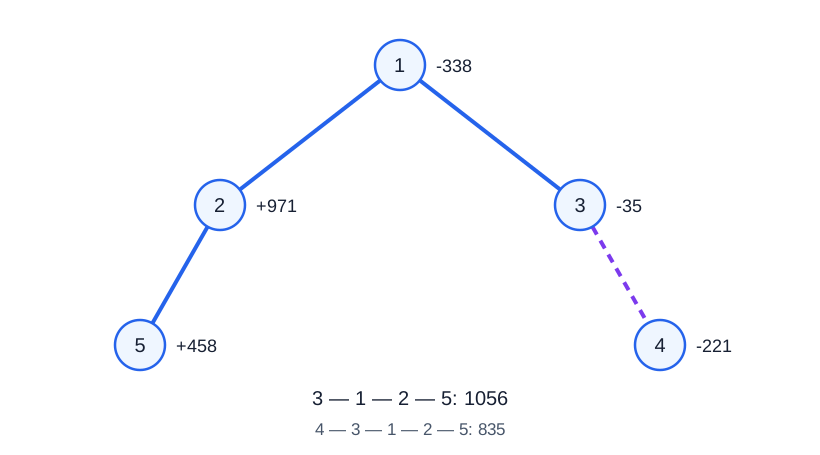
The solid highlight shows \(3\to1\to2\to5\) . The dashed segment extends it to vertex \(4\) . The tree is unrooted, so vertical placement does not restrict travel direction.
In sample 2, the zero-edge path has value \(-7\) . Every simple path in sample 3 has at most two edges, so none is valid.
Constraints and Guarantees
For all test cases: \(1\le n\le300000\) , \(0\le L\le R\le n-1\) , \(-1000\le v_i\le1000\) , and \(1\le u,v\le n\) . The input edges form a tree.
| Score | Additional restrictions |
|---|---|
| 100% | None |