Mental Omega Device
Time limit: 1 seconds. Memory limit: 512 MiB. Recalibrate as twice the slowest standard median in the target environment, rounded up to 0.5 seconds; see the environment.
Story
The Mental Omega Device is nearly complete; only testing and final activation remain! To verify its reliability, you need to write a program that simulates its operation. The device can be modeled as a tree rooted at vertex \(1\) , and its operation can be represented by the following operations.
Formal Problem Statement
An \(n\)-vertex tree is rooted at vertex 1. All vertex values are initially zero. Define:
- \(P(a,b)\) : the vertices on the simple path from \(a\) to \(b\) , including both endpoints.
- \(H(a,b)\) : all vertices outside \(P(a,b)\) that are adjacent to at least one path vertex. Count each vertex once.
- \(T(a)\) : the rooted subtree of \(a\) , including \(a\) .
Process \(m\) operations from this table in order.
| Operation | Set | Effect |
|---|---|---|
1 a b v |
\(P(a,b)\) | Add \(v\) to every value |
2 a b v |
\(H(a,b)\) | Add \(v\) to every value |
3 a v |
\(T(a)\) | Add \(v\) to every value |
4 a b v |
\(P(a,b)\) | Assign \(v\) to every value |
5 a b v |
\(H(a,b)\) | Assign \(v\) to every value |
6 a v |
\(T(a)\) | Assign \(v\) to every value |
7 a b |
\(P(a,b)\) | Query the maximum |
8 a b |
\(H(a,b)\) | Query the maximum |
9 a |
\(T(a)\) | Query the maximum |
10 a b |
\(P(a,b)\) | Query the sum |
11 a b |
\(H(a,b)\) | Query the sum |
12 a |
\(T(a)\) | Query the sum |
Updating an empty neighborhood has no effect. Its sum is zero, and its maximum query prints the uppercase word EMPTY .
Input Format
The first line contains n m . Each of the next \(n-1\) lines contains a tree edge u v . The next \(m\) lines contain operations. There is no initial-value array in the input.
Output Format
For each operation numbered 7 through 12, print its integer answer or EMPTY as specified.
Sample 1
Input
4 8
1 2
2 3
2 4
5 1 3 7
8 1 3
10 1 3
11 1 3
3 2 -2
9 2
12 2
7 1 3
Output
7
0
7
5
1
0
Sample 2
Input
1 6
8 1 1
11 1 1
2 1 1 5
4 1 1 -7
9 1
12 1
Output
EMPTY
0
-7
-7
Sample 3
Input
3 6
1 2
2 3
3 1 100000000
1 1 3 100000000
6 2 0
10 1 3
9 2
11 1 1
Output
200000000
0
0
Sample Explanation
In Sample 1, \(P(1,3)=\{1,2,3\}\) and \(H(1,3)=\{4\}\) . Set vertex 4 to 7, then add \(-2\) to \(T(2)\) ; its three values become \(-2,-2,5\) . Sample 2 illustrates an empty neighborhood.
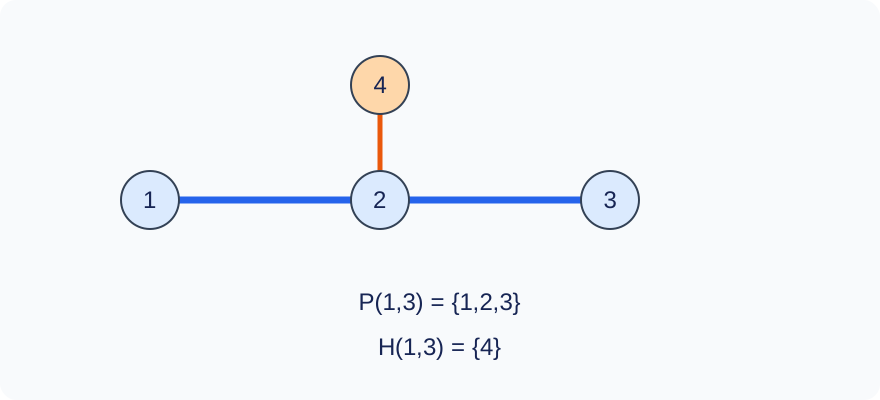
Blue vertices form \(P(1,3)\) ; the orange vertex is its external neighborhood.
Constraints and Scoring
\(1\le n,m\le10^5\) , all vertex indices lie in \([1,n]\) , and each update value has absolute value at most \(10^8\) . The input graph is a tree. Accumulated values and answers may exceed signed 32-bit integers.
Specifications redesigned by Codex (GPT-6): zero initial values, empty-neighborhood maximum and sum rules, and output for operations 7 through 12.
| Score | Additional constraints |
|---|---|
| 20% | \(n\le30,\ m\le100\) |
| 30% | \(n,m\le2000\) |
| 50% | No additional constraints |
There are 10 tests worth 10% each. See the test recipes.