Psychic Control Tree
- Indicative time limit: 2.0 s (environment and measurements).
- Actual time limit: twice the reference program's baseline time on the slowest official test file in the target environment, rounded up to a multiple of 0.5 seconds; round up further if the platform requires a coarser unit.
- Memory limit: 128 MB
Story
The psychic corps controls battlefield units through a control tree. Activating a node also activates all its descendants. The battlefield roads form a tree with the same structure. Controlled units must gather, eliminating any uncontrolled enemies on their routes. Evaluate the minimum cost for every possible activation node.
Formal Problem Statement
A tree has \(n\) vertices numbered \(1\) through \(n\) and is rooted at vertex \(1\) . The same tree represents both the control hierarchy and the battlefield roads.
Battlefield vertex \(i\) contains a unit of strength \(v_i\) . Control vertex \(i\) controls the unit at battlefield vertex \(e_i\) , where \(e\) is a permutation of \(1\) through \(n\) .
For each control vertex \(u\) , let \(S_u\) contain the battlefield vertices controlled by the vertices in the subtree of \(u\) . Choose any battlefield vertex as a meeting point and move all units in \(S_u\) to it along tree paths. Every uncontrolled unit on the routes must be eliminated, with its strength charged once. Controlled units cost nothing; an uncontrolled unit at the meeting point is also charged.
Find the minimum total cost for each \(u\) . These scenarios are independent.
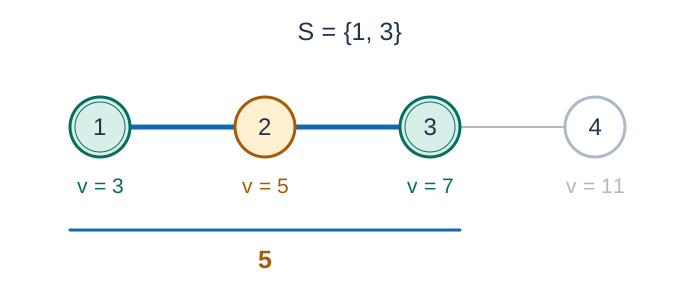
Figure 1: For controlled vertices \(\{1,3\}\) , meeting at vertex \(1\) , \(2\) , or \(3\) requires eliminating only the unit at vertex \(2\) , at cost \(5\) .
Input Format
The first line contains \(n\) . The next \(n\) lines contain \(v_i,e_i\) for \(i=1,\ldots,n\) . Each of the following \(n-1\) lines contains the endpoints \(a,b\) of an undirected tree edge.
Output Format
Print \(n\) lines. Line \(u\) contains the minimum cost for activating vertex \(u\) .
Sample 1
Input
7
1 1
1 7
1 2
1 6
1 5
1 4
1 3
1 2
2 3
2 4
1 5
5 6
5 7
Output
0
2
0
0
2
0
0
Explanation
Activating vertex \(2\) controls battlefield vertices \(\{7,2,6\}\) . Connecting them also passes through vertices \(1,5\) , costing \(2\) . Activating the root controls every unit and costs zero.
Sample 2
Input
4
3 2
5 4
7 1
11 3
1 2
2 3
3 4
Output
0
5
5
0
Explanation
Activating vertex \(3\) controls battlefield vertices \(1,3\) . Their path passes through vertex \(2\) , costing \(v_2=5\) . Activating vertex \(2\) also controls vertex \(4\) and still costs only the strength at vertex \(2\) .
Constraints and Guarantees
- \(1\le n\le100000\) and \(1\le v_i\le5000\) .
- \(e\) is a permutation of \(1\) through \(n\) , and the edges form a tree.
Test Groups
| Score share | Additional conditions |
|---|---|
| 100% | No additional conditions |