Spice Routes
- Indicative time limit: 0.5 s (environment and measurements).
- Actual time limit: twice the reference program's benchmark time on its slowest official test file in the target environment, rounded up to a multiple of 0.5 seconds, then to the platform's supported granularity if coarser.
- Memory limit: 128 MB
Story
A spice trader has a network of planets. Some sell spice cheaply, and others buy it at a high price. Static interference may block routes to loaded ships. Find the probability that at least one seller and one buyer remain connected.
Formal Problem Statement
You are given an undirected tree on \(n\) nodes. Edge \(i\) fails with probability \(q_i/p_i\) , independently of all other edges. Failed edges cannot be used; all other edges work in both directions.
You are also given lists of low-price and high-price nodes. Repetition is allowed within and across the lists; repeating a node adds no requirement. If a node belongs to both categories, its zero-length path counts as a connection.
Find the probability that at least one low-price node and one high-price node remain connected after all failed edges are removed. If the probability is \(x/y\) in lowest terms, output \(x\cdot y^{-1}\bmod P\) , where \(P=10^9+7\) and \(y^{-1}\) is the multiplicative inverse modulo \(P\) .
Input Format
The first line contains \(n\) . Each of the next \(n-1\) lines contains \(u,v,q_i,p_i\) , describing an edge and its failure probability. Then follow the integer \(a\) , a line of \(a\) low-price node IDs, the integer \(b\) , and a line of \(b\) high-price node IDs. An empty list has an empty ID line.
Output Format
Print the probability modulo \(P\) as one integer.
Example 1
Input
5
1 2 0 1
2 3 0 1
2 4 1 2
2 5 1 2
2
4 5
2
1 3
Output
750000006
Example 2
Input
3
1 2 1 2
2 3 1 3
2
1 3
1
2
Output
833333340
Example 3
Input
1
1
1
2
1 1
Output
1
Example Explanation
In example 1, nodes \(1,2,3\) are always connected. At least one of the edges to nodes \(4\) and \(5\) must survive, with probability \(1-(1/2)^2=3/4\) . The probability in example 2 is \(1-(1/2)(1/3)=5/6\) . The only node in example 3 belongs to both categories, so the probability is \(1\) .
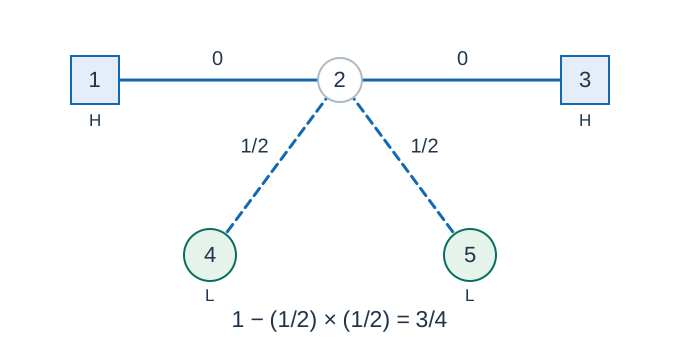
L marks low-price nodes and H marks high-price nodes. Edge labels give failure probabilities.
Constraints and Guarantees
All inputs satisfy \(1\le n\le100000\) , \(0\le a\le n\) , \(0\le b\le2\) , \(0\le q_i\le p_i\le100000\) , and \(p_i\ge1\) . Node IDs are in \([1,n]\) , and the edges form a tree. All denominators are smaller than the prime \(P\) , so the required inverse exists.
| Score share | Additional conditions |
|---|---|
| 100% | No additional conditions |