Tolerance Paths in a Tree
Time limit: 1 seconds. Memory limit: 128 MiB. See the reference environment and measurements.
Story
Sensors pass signals along a tree. Each link offers several possible signal strengths, and each sensor limits how much the strength may change. For each starting sensor, count the positions a signal can reach.
(This story was rewritten by GPT-6.)
Formal Problem Statement
An undirected tree has \(n\) vertices and edges numbered \(1,\ldots,n-1\) in input order. There are also \(m\) undirected special edges. Each special edge is attached to one tree edge, joins its two endpoints, and has an integer weight. Several special edges may share a tree edge or a weight. A tree edge with no special edge cannot be traversed.
Vertex \(v\) has tolerance \([L_v,R_v]\) . Walk only along special edges, using each underlying tree edge at most once. The first special edge has no weight restriction. At each later transition through vertex \(v\) , an incoming weight \(p\) and outgoing weight \(w\) must satisfy
For every start vertex, count the vertices reachable by at least one legal route. Include the start itself via the empty route. Different destinations may use different routes and special-edge choices.
Input Format
The first line contains n m . The next \(n-1\) lines contain tree edges u v . The next \(n\) lines contain L_v R_v for vertices \(v=1,\ldots,n\) . The final \(m\) lines contain e w , specifying a special edge of weight \(w\) attached to tree edge \(e\) .
Output Format
Print \(n\) integers on one line, in vertex order.
Sample 1
Input
4 5
1 2
2 3
3 4
0 0
0 0
1 1
0 0
1 0
1 2
2 1
3 2
3 3
Output
2 4 3 2
Sample 2
Input
1 0
-1000000000 1000000000
Output
1
Sample 3
Input
3 0
1 2
2 3
0 0
0 0
0 0
Output
1 1 1
Sample Explanation
In Sample 1, a route from 1 cannot pass through 2: its possible incoming weights are 0 and 2, neither of which can change by zero to weight 1. From 2, weights 1 then 2 reach 3 and 4. Reachability need not be symmetric.
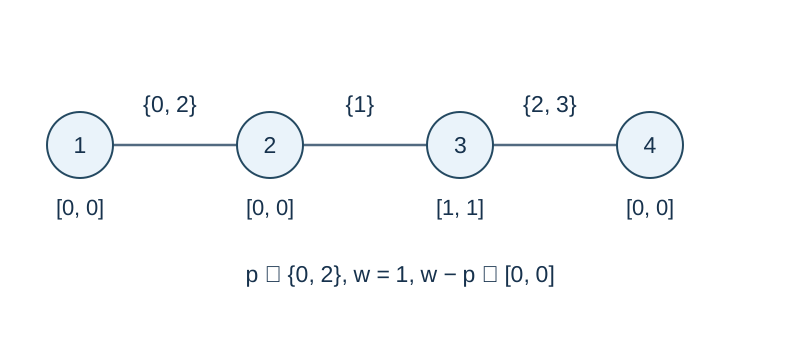
Lines are underlying tree edges; braces list available special-edge weights. The zero tolerance at vertex 2 cannot fill gaps in the weight set.
Constraints and Scoring
\(1\le n\le1000\) , \(0\le m\le20000\) , \(-10^9\le L_v\le R_v\le10^9\) , and \(|w|\le10^9\) . The underlying input graph is a tree. If \(n=1\) , then \(m=0\) .
Specifications redesigned by Codex (GPT-6): bounds, edge-index input, duplicate weights, empty routes, and first-step semantics.
| Score | Additional constraints |
|---|---|
| 20% | \(n\le8,\ m\le15\) |
| 30% | \(n\le100,\ m\le1000\) |
| 50% | No additional constraints |