Alien Factory: Signal Network
Estimated time limit: 0.5 seconds. Memory limit: 128 MB.
The deployed limit is twice the largest per-input median runtime of the reference program on the target judge, rounded up to a multiple of \(0.5\) seconds. See the reference measurements.
Story
A factory controls its power equipment through a signal network. To avoid repeated switching near a charge threshold, an engineer combines binary signals and packages rotations, interval flips and readout into reusable devices. Simulate one of these signal registers.
Formal Problem Statement
Maintain an unsigned \(128\)-bit binary integer \(A\) , initially zero. Number its bits \(0,1,\ldots,127\) from least significant to most significant; bit \(i\) has weight \(2^i\) .
| Operation | Meaning |
|---|---|
1 x |
Rotate the whole register right by \(x\) bits. A negative value means a left rotation by its absolute value. |
2 |
Print the nonnegative integer represented by the lowest \(16\) bits, in uppercase hexadecimal. |
3 l r |
Flip every bit whose index belongs to the closed interval \([l,r]\) . |
A rotation preserves the bits shifted out at one end and places them at the other end. Let \(k\) be the nonnegative remainder of \(x\) modulo \(128\) . New bit \(i\) equals old bit \((i+k)\bmod128\) . A rotation with \(k=0\) changes nothing.
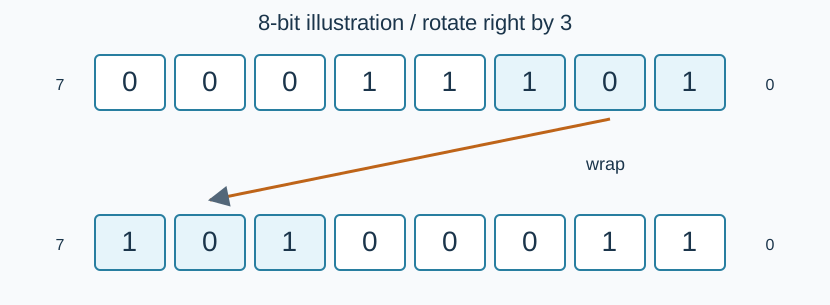
The diagram illustrates a right rotation by \(3\) in an \(8\)-bit register: 00011101 becomes 10100011 . The actual problem always uses \(128\) bits.
Input
The first line contains the number of operations \(N\) . Each of the next \(N\) lines contains one operation in the format above.
Output
For every 2 operation, print one hexadecimal number using digits 0 through 9 and uppercase letters A through F . Omit the 0x prefix and unnecessary leading zeros. Print 0 for zero. The other operations produce no output.
Samples
Sample 1
Input
12
2
3 0 3
2
1 1
2
1 -1
2
3 0 0
2
1 128
2
2
Output
0
F
7
F
E
E
E
Sample 2
Input
8
3 0 127
2
3 63 64
1 64
2
1 0
3 0 15
2
Output
FFFF
FFFE
1
Sample 3
Input
0
Output
Sample explanations
Sample 1 first sets the lowest four bits, producing F . After one right rotation, the lowest sixteen bits give 7 , while one bit wraps to the highest position. The reverse rotation restores the state. Sample 2 crosses the boundary between bits \(63\) and \(64\) . Sample 3 contains no operations.
Constraints and guarantees
For all inputs: \(0\le N\le2\times10^6\) , \(|x|\le10^9\) , and \(0\le l\le r\le127\) .
| Score | Additional conditions |
|---|---|
| 100% | No additional conditions |