A Certain Unscientific Count of Monotone Sequences
- Reference time limit: 0.5 seconds (environment R30; estimate only).
- Actual time limit: twice the standard program’s baseline time on the slowest official test file in the target environment, rounded up to a multiple of 0.5 seconds.
- Memory limit: 128 MB
Story
While working through the paper for Academy City's Zeroth High School Mock Exam, Xiao A came across an interesting mathematics problem and decided to use his knowledge of algorithms to expand its input bounds.
Formal Problem Statement
Given positive integers \(n,m\) , count integer sequences with \(1\le x_1\le x_2\le\cdots\le x_n\le m\) , modulo \(p=998244353\) . Two sequences differ if they have different values at any position.
Input Format
One line contains \(n,m\) .
Output Format
Print the number of sequences modulo \(p\) .
Sample 1
Input
3 2
Output
4
Explanation
The sequences are \((1,1,1),(1,1,2),(1,2,2),(2,2,2)\) .
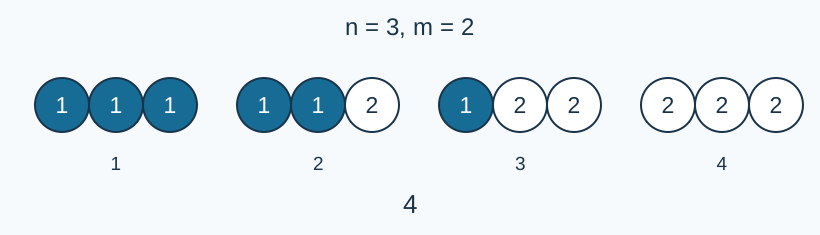
Each group of three circles represents one sequence; numbers are labels.
Sample 2
Input
1 5
Output
5
Explanation
The single element can use any available label.
Sample 3
Input
5 1
Output
1
Explanation
Every position must contain one.
Constraints and Guarantees
\(1\le n,m\le2000\) . All inputs are integers.
Test Groups
| Score | Additional restriction |
|---|---|
| 20% | \(n,m\le10\) |
| 30% | \(\min(n,m)\le50\) |
| 50% | No additional restriction |