Counting Paired DNA Strands
Estimated time limit: 0.5 seconds. Memory limit: 128 MB.
The actual time limit is twice the slowest-case median runtime of the reference solution on the target judge, rounded up to a multiple of \(0.5\) seconds. See the benchmark environment.
Story
In this model of double-stranded, non-circular DNA, the two strands are complementary and run in opposite directions. Count molecule types for a given number of base pairs. The string definition below specifies when two representations describe one molecule.
Formal Problem Statement
The alphabet is A , T , C , G , with complementary pairs A–T and C–G . Every letter has exactly one complement.
A molecule with \(n\) base pairs is represented by a string \(s=s_1\cdots s_n\) of length \(n\) . Its reverse complement is
An overline means taking the complementary letter. Two strings describe the same molecule exactly when they are equal or one is the reverse complement of the other.
Each query gives \(n\) and asks for the number of molecule types modulo \(10^9+7\) . There are \(m\) queries; output only the bitwise XOR of their individual residues.
Input Format
The first line contains \(m\) . Each of the next \(m\) lines contains a query length \(n\) .
Output Format
Print one nonnegative integer: first reduce each query count modulo \(10^9+7\) , then take their bitwise XOR.
Samples
Sample 1
Input
3
1
2
3
Output
40
Sample 2
Input
4
1
1
2
2
Output
0
Sample 3
Input
1
4
Output
136
Sample Explanation
For lengths one, two, and three, the counts are \(2,10,32\) , so the first sample gives \(2\mathbin{\oplus}10\mathbin{\oplus}32=40\) . Each length occurs twice in the second sample, making the XOR zero. Length four has \(136\) types, giving the third sample.
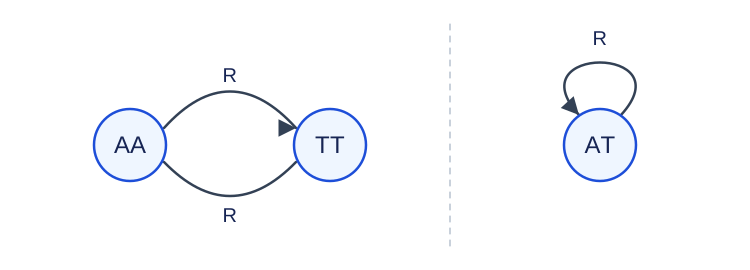
Arrows apply reverse complementation. AA and TT form one class; AT is its own reverse complement. Each diagram counts as one molecule.
Constraints and Guarantees
For all inputs, \(1\le m\le500000\) and \(1\le n\le10^9\) . Queries may repeat.
| Score share | Additional conditions |
|---|---|
| 100% | None |