Boards with No All-Black Line
Indicative time limit: 0.5 seconds. Memory limit: 8 MiB. Recalibrate as twice the slowest standard median in the target environment, rounded up to 0.5 seconds. See the environment.
Story
A princess living on a mountaintop finds ordinary tic-tac-toe too small. On a larger board, she requires a white cell in every row, every column, and both long diagonals. Count the boards she can use.
Formal Problem Statement
Color every cell of an \(n\times n\) board black or white. Every row, every column, the main diagonal, and the opposite diagonal must contain at least one white cell.
The main diagonal consists of \((i,i)\) , and the opposite diagonal consists of \((i,n+1-i)\) , for \(1\le i\le n\) . Only these two length-\(n\) diagonals are checked. Board positions are distinguished: rotations and reflections are counted separately.
For each \(n=0,1,\ldots,20\) , find the number of boards modulo \(P=10^9+7\) . The empty board has one coloring by convention.
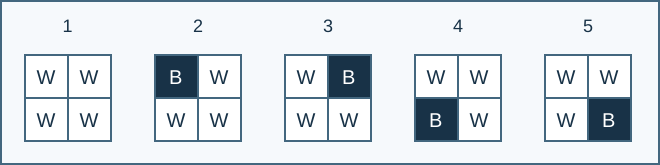
For \(n=2\) , the five valid boards are the all-white board and the four boards with exactly one black cell. W means white and B means black.
Input Format
There is no input.
Output Format
Print 21 lines, giving the answers for \(n=0\) through \(n=20\) , in order.
Sample 1
Input
Output
1
1
5
230
38154
23837323
867090702
313119612
923973197
462403141
840792457
982585751
463056058
199254391
8125702
241056829
669505845
625652964
167694588
415136241
104359615
Constraints and Scoring
There is no variable input. All 21 answers must be printed.
Specification adjustment by Codex (GPT-6), recorded as a redesign: the whole-process memory limit is 8 MiB to accommodate the reference Windows runtime overhead. The input domain and counting or queue rules are unchanged.
| Score | Additional constraints |
|---|---|
| 100% | None |
There is one formal empty input file worth 100%. See the test recipes.