Lower-Weight Imperfect Non-Matching
Time limit: 0.5 seconds. Memory limit: 128 MiB. Recalibrate as twice the slowest standard median in the target environment, rounded up to 0.5 seconds; see the environment.
Story
“Full preparation can never lead to action!”
You are given a connected undirected weighted graph. Start at vertex \(1\) , visit every vertex at least once, return to vertex \(1\) , and list the edges you traverse in order.
You do not have to find the shortest walk. A preliminary solution, which need not be optimal, has already been prepared. Your score depends on how your walk's total weight compares with that benchmark. Construct a valid walk that earns full credit.
Formal Problem Statement
You are given a connected undirected weighted graph with \(n\) vertices and \(m\) edges. Vertices are numbered \(1,\ldots,n\) , and edges are numbered \(1,\ldots,m\) in input order. Parallel edges and self-loops are allowed.
Output a sequence of edge IDs describing a walk that starts at vertex \(1\) , follows the listed edges in order, visits every vertex at least once, and returns to vertex \(1\) . Edges may be reused, but the sequence may contain at most \(5n\) edge occurrences. The start is already visited before taking any edge; the empty walk is valid when \(n=1\) .
Let \(W\) be the minimum spanning tree weight and \(B=2W\) . For a valid output, let \(Y\) be its total weight, counting repeated traversals separately. Its score out of 100 for one test is
Invalid output scores zero. When \(B=0\) , the middle branch is impossible: a valid zero-cost walk scores 100 and any other valid walk scores 40. Weight each test's score by the table below. Your task is to output a valid walk earning full credit.
Input Format
The first line contains n m . Each of the next \(m\) lines contains u v w , describing an undirected edge with endpoints \(u,v\) and weight \(w\) .
Output Format
Print the number \(k\) of edge occurrences on the first line, followed by one edge ID on each of the next \(k\) lines. Any full-credit answer is accepted; sample outputs are not unique.
Sample 1
Input
3 3
1 2 1
2 3 2
1 3 5
Output
4
1
2
2
1
Sample 2
Input
1 0
Output
0
Sample 3
Input
2 3
1 1 9
1 2 0
1 2 4
Output
2
2
2
Sample 4
Input
5 5
1 2 1
2 3 1
3 4 1
4 5 1
1 5 3
Output
5
1
2
3
4
5
Sample Explanation
In Sample 1, traversing the tree edges of weights 1 and 2 twice costs 6, exactly the baseline \(B\) . In Sample 2, the starting vertex already covers the graph. The five-edge circuit in Sample 4 costs 7 and also earns full credit.
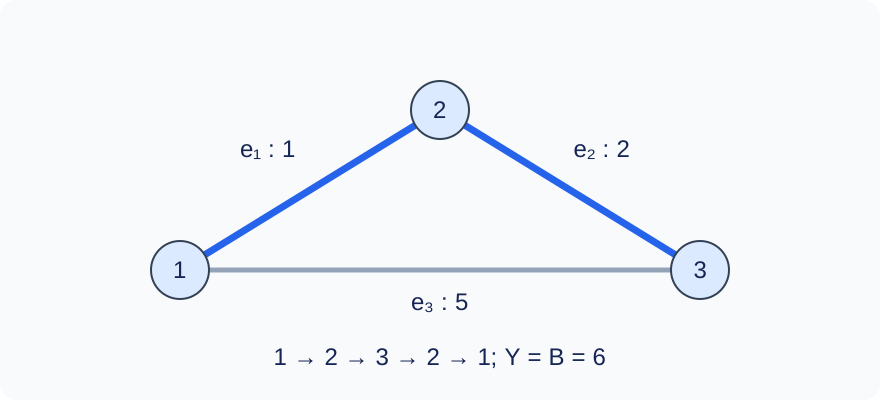
The bold edges form a minimum spanning tree. Traversing edge IDs 1 and 2 out and back visits all three vertices.
Constraints and Scoring
\(1\le n\le10^5\) , \(n-1\le m\le2\cdot10^5\) , \(1\le u,v\le n\) , and \(0\le w\le10^4\) . The graph is connected.
| Score | Additional constraints |
|---|---|
| 20% | \(n\le8,\ m\le15\) |
| 30% | \(n\le1000,\ m\le3000\) |
| 50% | No additional constraints |
There are 10 tests worth 10% each. See the test recipes.