Factorio: Roboport Network
Estimated time limit: 0.5 seconds. Memory limit: 128 MB.
On the target judge, use twice the largest per-case median runtime of the reference program, rounded up to a multiple of \(0.5\) seconds. See the reference environment.
Story
In Factorio, robots rely on roboports to coordinate their work. The roboports form a ring. As mines close and production lines open, roboports must be removed or added, and the current control position must move through the network.
Formal Problem Statement
Initially, \(n\) roboports numbered \(1,2,\ldots,n\) form a ring in that order. The current roboport is \(1\) .
Direction \(0\) follows \(1\to2\to\cdots\to n\to1\) ; direction \(1\) is the reverse. After insertions or deletions, these directions follow the corresponding neighboring links of the ring.
Process \(m\) operations in order:
0: remove the current roboport and make its direction-\(0\) successor current. Removing the only roboport makes the ring empty. Ignore this operation on an empty ring.1: insert a new roboport between the current roboport and its direction-\(0\) successor, keeping the current roboport unchanged. On an empty ring, insert the only roboport and make it current.2 x: move \(x\) steps in direction \(0\) .3 x: move \(x\) steps in direction \(1\) .4: report the current roboport number, or-1if the ring is empty.
Each insertion receives one more than the largest number ever assigned. Numbers are never reused. A negative step count means movement in the opposite direction. Ignore movement on an empty ring. In a one-roboport ring, both successors are the roboport itself.
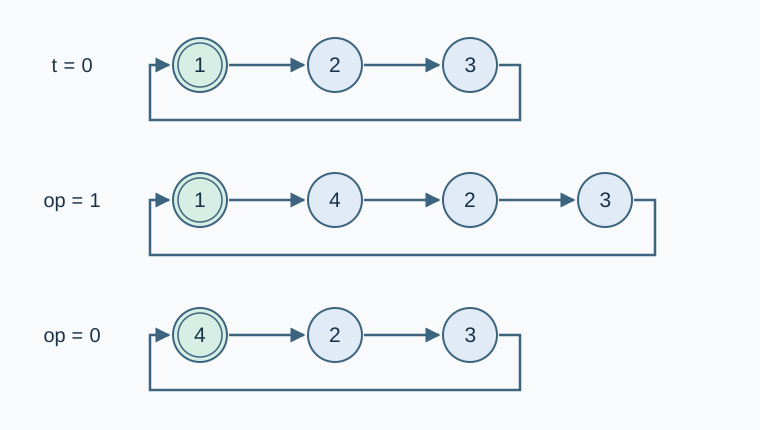
Arrows show direction \(0\) ; double circles mark the current roboport. The rows show the initial state, the result of 1 , and the result of a subsequent 0 . Direction \(1\) opposes the arrows.
Input
The first line contains \(n,m\) . Each of the next \(m\) lines contains an operation in the format above.
Output
Output one line for each 4 operation. If there are no queries, the output is empty.
Samples
Sample 1
Input
3 26
4
2 100
4
3 -100
4
1
4
2 1
4
2 0
4
0
4
0
4
0
4
0
4
1
4
1
1
4
2 2
4
Output
1
2
3
3
4
4
1
2
3
-1
5
5
6
Sample 2
Input
4 51
4
2 1
4
2 1
4
2 1
4
2 1
4
3 1
4
0
4
2 1
4
3 1
4
3 1
4
1
4
2 1
4
3 1
4
2 2
4
0
4
0
4
0
4
0
4
0
4
1
4
2 1000
4
1
1
1
1
1
1
2 1000
4
3 -5000
4
Output
1
2
3
4
1
4
1
2
1
3
3
5
3
1
2
3
5
-1
-1
6
6
7
12
Sample 3
Input
1 12
4
0
4
2 -1000000000
1
4
1
3 -1
4
0
4
4
Output
1
-1
2
3
2
2
Sample Explanation
Samples 1 and 2 illustrate wraparound, negative steps, insertion, and repeated deletion. Inserting into a nonempty ring does not move to the inserted roboport.
In sample 3, removing the only roboport leaves an empty ring. The next insertion receives number \(2\) . Another insertion creates number \(3\) , and 3 -1 moves one step in direction \(0\) .
Constraints and Guarantees
For 100% of the data: \(1\le n,m\le10^5\) , and \(-10^9\le x\le10^9\) .
For every movement on a nonempty ring, let \(s\) be its current size and \(r\) the nonnegative remainder of \(x\) modulo \(s\) . It is guaranteed that \(\min(r,s-r)\le500\) : after removing full laps and choosing the shorter direction, at most \(500\) steps are needed. This condition does not apply to movement on an empty ring.
| Score | Additional conditions |
|---|---|
| 100% | None |