Vacuum Imploder
- Indicative time limit: 1.0 s (environment and measurements).
- Actual time limit: 2 times the reference solution's baseline runtime on its slowest official test file in the target judging environment, rounded up in 0.5 s increments; if the judge only supports coarser increments, round up again to a supported value.
- Memory limit: 128 MB
Story
A battle laboratory is simulating how a Vacuum Imploder affects vehicle positions. Researchers number the vehicles, apply translations, reflections, or rotations to ranges of IDs, and inspect coordinates during the simulation. Maintain the resulting positions.
Formal Problem Statement
There are \(n\) points with fixed IDs \(1\) through \(n\) and initial coordinates \((x_i,y_i)\) . Process \(m\) operations in input order. IDs do not change when points move. Every range \([l,r]\) is an inclusive range of IDs.
0 l r a: replace \((x,y)\) by \((x+a,y)\) for these points.1 l r a: replace it by \((x,y+a)\) .2 l r: reflect across the \(x\) axis, giving \((x,-y)\) .3 l r: reflect across the \(y\) axis, giving \((-x,y)\) .4 l r: reflect across \(x=y\) , giving \((y,x)\) .5 l r: reflect across \(x=-y\) , giving \((-y,-x)\) .6 l r b: rotate counterclockwise by \(b\) degrees about the origin.7 i: query the current coordinates of point \(i\) .
Use Cartesian coordinates, with the \(x\) axis pointing right and the \(y\) axis pointing up. For \(\theta=b\pi/180\) , the rotation gives
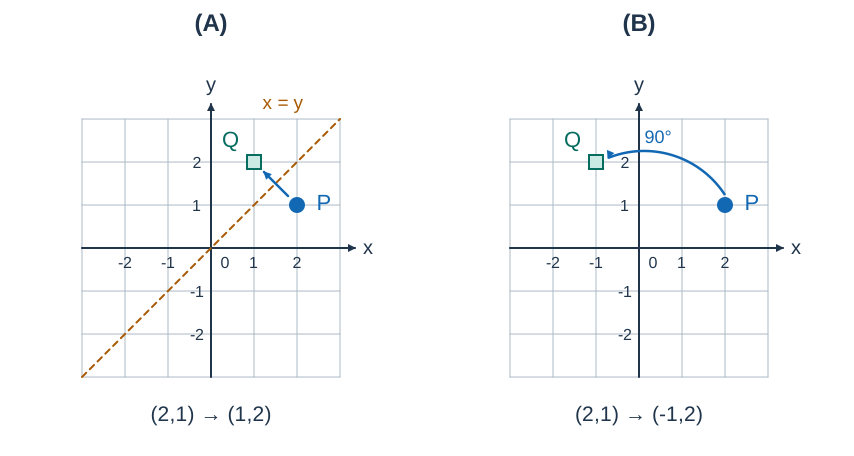
Figure 1: Both panels independently start from \(P=(2,1)\) . A applies operation 4 ; B applies operation 6 with angle \(90\) . The circle P marks the starting point and the square Q marks the result.
Output every query result. After all operations, also output the final coordinates of every point in ID order.
Input Format
The first line contains \(n,m\) . The next \(n\) lines contain the initial integer coordinates \(x_i,y_i\) . The next \(m\) lines describe operations in the formats above.
Output Format
For each operation 7 , print two real numbers on one line. After all operations, print \(n\) further lines, each containing the final coordinates of the corresponding point.
An absolute error of at most \(0.05\) in each coordinate is accepted. The number of output rows is the number of queries plus \(n\) , rather than the number of operations plus \(n\) .
Sample 1
Input
10 30
1470 7211
4180 -960
-2962 -5944
-9984 -6050
-6674 6625
-1462 -6774
-1042 -4576
-2533 1499
9729 5985
4800 179
5 4 10
2 6 10
4 5 6
5 4 9
5 4 8
0 3 4 63
5 1 1
6 2 6 99
0 4 8 35
4 6 10
5 1 2
7 7
4 3 5
4 1 7
0 9 10 87
1 5 10 -47
2 3 4
5 4 8
5 9 10
0 10 10 40
7 5
3 5 7
6 7 8 19
5 5 8
7 3
6 6 9 17
0 6 9 -38
3 3 6
2 1 10
6 3 7 46
Output
-1042.00 4611.00
-7581.21 -5534.39
6324.32 1933.46
7211.00 -1470.00
-294.28 4278.71
-3002.43 -5892.43
4646.96 -10709.75
-9297.98 1285.24
5216.82 4595.75
3868.25 2670.62
-2622.19 1421.68
11086.12 2948.46
266.00 4887.00
Explanation
The first three rows answer the three queries; the next ten give the final positions.
Sample 2
Input
2 6
2 1
-1 0
7 1
4 1 1
6 1 2 90
0 1 2 3
5 2 2
7 2
Output
2.00 1.00
1.00 -3.00
1.00 1.00
1.00 -3.00
Explanation
The first point becomes \((1,2)\) , then \((-2,1)\) , then \((1,1)\) . The second point ends at \((1,-3)\) .
Constraints and Guarantees
- \(1\le n,m\le50000\) .
- Initial coordinates satisfy \(\lvert x_i\rvert,\lvert y_i\rvert\le10000\) .
- \(1\le l\le r\le n\) , \(1\le i\le n\) , \(-100\le a\le100\) , and \(0\le b\le360\) .
- All input values are integers. There may be no queries; final coordinates must still be printed.
Test Groups
| Score share | Additional conditions |
|---|---|
| 100% | No additional conditions |