An Edge-Weight Game on a Changing Cycle
Indicative time limit: 0.5 seconds. Memory limit: 256 MiB. Recalibrate as twice the slowest standard median in the target environment, rounded up to 0.5 seconds. See the environment.
Story
A games club designs a two-player game on a ring of edges with counters. Members keep editing the ring and want to know whether the first player can win from a fixed starting point after each edit.
(This story was rewritten by GPT-6.)
Formal Problem Statement
Starting from a fixed vertex \(s\) , the clockwise edge-weight sequence \(w_1,\ldots,w_n\) forms an undirected cycle. Two players alternate, with a token initially at \(s\) . A move chooses a positive-weight edge incident to the token, moves along it, and decreases its weight to any strictly smaller nonnegative integer. A player unable to move loses. Both players play optimally.
Every move strictly decreases the sum of weights, so play terminates. Determine whether the first player has a winning strategy.
Process \(q\) edits of the edge sequence in order:
1 R V: change edge \(R\) to weight \(V\) .2 R V: insert a weight-\(V\) edge immediately before the current edge \(R\) . The position \(R=n+1\) appends it at the end.3 R: delete edge \(R\) .
After an edit, rebuild the cycle from the resulting sequence. The start remains the junction between its last and first edges. Every state starts an independent game: hypothetical decreases during play do not alter the sequence used by subsequent edits.
For short sequences, use these conventions: if \(n=0\) , there is an isolated start and no move; if \(n=1\) , the edge is a self-loop and moving along it leaves the token at the start; if \(n=2\) , the two edges are distinct parallel edges between the same two vertices. For \(n\ge3\) , the graph is the usual simple cycle.
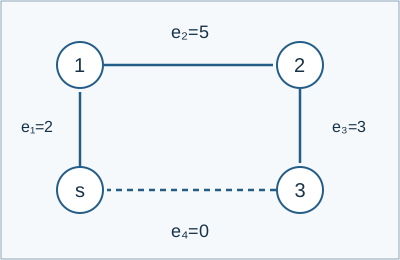
In Sample 1, the first player traverses the weight-2 edge and reduces it to zero, leaving a path of length two for the opponent, and can therefore win.
Input Format
The first line contains n q . The second gives \(n\) initial edge weights in clockwise order; it is empty when \(n=0\) . Each of the next \(q\) lines is an edit.
Output Format
Print \(q+1\) lines: the initial state followed by the state after each edit. Print 1 if the first player wins, and 0 otherwise.
Sample 1
Input
4 0
2 5 3 0
Output
1
Sample 2
Input
4 4
2 2 2 3
1 1 0
1 4 0
3 1
2 1 2
Output
1
1
0
0
1
Sample 3
Input
0 3

2 1 0
1 1 7
3 1
Output
0
0
1
0
Constraints and Scoring
Initially \(0\le n\le10^5\) , and \(0\le q\le10^5\) . All edge and update weights belong to \([0,100]\) . Changes and deletions satisfy \(1\le R\le\) the current edge count; insertions satisfy \(1\le R\le\) the current edge count plus one. The count may exceed its initial bound, but never exceeds the initial \(n+q\) .
Completed by Codex (GPT-6) and recorded as a redesign: cycles of zero, one, and two edges, insertion positions, and independent games for each state are explicitly defined.
| Score | Additional constraints |
|---|---|
| 100% | None |
There are ten formal files worth 10% each.
See the test recipes.