Counting Downhill Routes
Estimated time limit: 0.5 seconds. Memory limit: 128 MB.
The limit is twice the slowest median runtime of the reference program on the target platform, rounded up to a multiple of \(0.5\) seconds. See the evaluation environment.
Story
A mountain survey records the elevations of junctions and the roads between them. A team moves only downhill and wants to count all available routes.
(This story was rewritten by GPT-6.)
Formal Problem Statement
There are \(n\) vertices labelled \(1,\ldots,n\) , with vertex \(i\) at height \(h_i\) . There are \(m\) undirected roads. Road \(i\) has identifier \(i\) and joins \(u_i,v_i\) .
Start at any vertex. Each move uses exactly one road to reach a vertex of strictly smaller height. You may stop at any time, including before making a move.
A route is represented by its starting vertex followed by the identifiers of the roads used, in order. Distinct sequences are distinct routes. Thus, parallel roads are counted separately. Equal-height roads and self-loops cannot be used. Routes making no moves are distinguished by their starting vertices.
Find the least nonnegative residue of the number of routes modulo \(998246353\) . There are no routes when \(n=0\) .
Input Format
The first line contains \(n,m\) . The second contains \(h_1,\ldots,h_n\) . Each of the next \(m\) lines contains \(u_i,v_i\) , describing road \(i\) . If \(n=0\) , the height line is empty and \(m=0\) .
Output Format
Print the route count modulo the specified modulus.
Samples
Sample 1
Input
5 5
1 2 3 4 5
5 4
5 3
4 3
3 2
2 1
Output
18
Sample 2
Input
2 3
2 1
1 2
1 2
1 1
Output
4
Sample 3
Input
0 0
Output
0
Sample Explanation
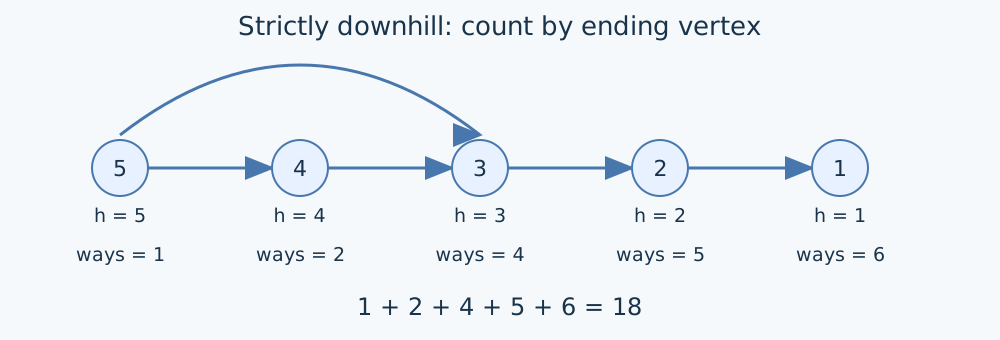
In the first sample, the counts ending at vertices one through five are \(6,5,4,2,1\) , totalling eighteen. The second has two zero-move routes and two routes using road one or road two; its self-loop cannot be used downhill. The third has no starting vertex.
Constraints and Guarantees
\(0\le n,m\le10^5\) , \(-10^5\le h_i\le10^5\) , \(1\le u_i,v_i\le n\) .
| Score | Additional constraints |
|---|---|
| 50% | \(n,m\le300\) |
| 50% | None |