Integer Calculator
Estimated time limit: 0.5 seconds. Memory limit: 128 MB.
The actual limit is twice the slowest per-case median time of the standard program on the target judge, rounded up to a multiple of \(0.5\) seconds. See the evaluation notes.
Story
An automated factory needs a small calculator for control expressions. It uses fixed 32-bit integer rules and reports an error when a divisor is zero.
Formal Problem Statement
Evaluate a valid expression. A numeric literal is exactly one of \(0,\ldots,9\) ; multi-digit literals are not allowed. Parentheses ( and ) change grouping. The table lists operators from highest to lowest precedence.
| Operators | Meaning | Associativity |
|---|---|---|
Unary + - ~ |
Positive, negate, bitwise complement | Right to left |
Binary * / % |
Multiply, divide, remainder | Left to right |
Binary + - |
Add, subtract | Left to right |
Binary < > |
Less than, greater than | Left to right |
There are no increment or decrement operators. Interpret consecutive signs according to their unary or binary positions. For example, -~1 means -(~1) , and 3<2<1 means (3<2)<1 .
Every value is a signed 32-bit integer in \([-2^{31},2^{31}-1]\) . Reduce the mathematical result of addition, subtraction, multiplication, or unary negation modulo \(2^{32}\) , then interpret it as two's complement. Bitwise complement flips all 32 bits.
Division truncates toward zero. The remainder satisfies \(a\bmod b=a-\operatorname{trunc}(a/b)b\) , and is zero or has the dividend's sign. The result of \(-2^{31}/(-1)\) also wraps to \(-2^{31}\) ; its remainder is zero. Comparisons use signed values and return \(0\) or \(1\) .
All operands are evaluated. If any division or remainder has a zero divisor, print Runtime Error . Otherwise, print the final integer.
Input
One line contains one expression without spaces. There is exactly one expression in the input.
Output
Print one line containing the result or Runtime Error .
Examples
Example 1
Input
--~~-~(5)+++--(3*(6+7)*4)*2/(2+2)+(1>(((2))))
Output
84
Example 2
Input
3<2<1
Output
1
Example 3
Input
9*9*9*9*9*9*9*9*9*9*9
Output
1316288537
Example 4
Input
5/(7-6-1)
Output
Runtime Error
Example Explanation
Sample 1 evaluates to 84. Sample 2 first evaluates 3<2 to 0, then 0<1 to 1. Sample 3 retains the low 32 bits of \(9^{11}\) , obtaining 1316288537. Sample 4 has a zero divisor.
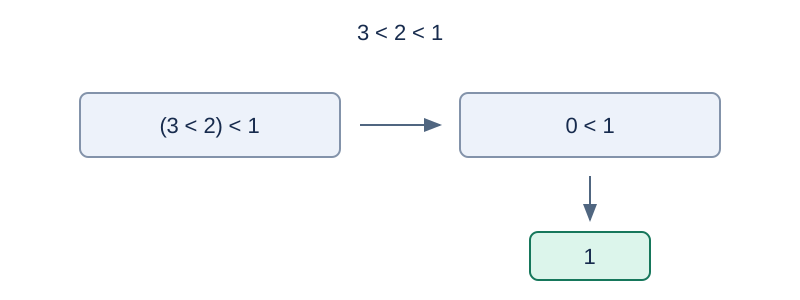
The result of a comparison can be an operand of the next comparison.
Constraints and Guarantees
The expression has length \(\ell\) , where \(1\le\ell\le100000\) . Its syntax is valid. There is no additional bound on parenthesis or unary-operator nesting depth.
Specifications redesigned by Codex (GPT-6): 32-bit wrapping, signed division and remainder, and division of the minimum signed value by minus one are explicit.
| Score | Additional conditions |
|---|---|
| 20% | \(\ell\le30\) |
| 30% | \(\ell\le1000\) |
| 50% | No additional conditions |