Budget Selection from a Generated Sequence
Estimated time limit: 1.0 seconds. Memory limit: 128 MB.
The actual limit is twice the slowest per-case median time of the standard program on the target judge, rounded up to a multiple of \(0.5\) seconds. See the evaluation notes.
Story
A recycling station generates processing costs for a large batch from a few parameters. Some items earn refunds, so costs may be negative. The station wants to process as many items as its budget allows.
(This story was rewritten by GPT-6.)
Formal Problem Statement
Given \(n,A,B,C,D,L\) , set \(x_0=A\) and generate, in order for \(i=1,\ldots,n\) ,
Here \(\operatorname{rem}(u,v)=u-\operatorname{trunc}(u/v)v\) , division truncates toward zero, and \(D\ne0\) . The remainder is zero or has the sign of \(u\) ; \(D\) may be negative. Use exact integer multiplication during generation, without 32-bit wrapping.
Choose distinct positions from \(x_1,\ldots,x_n\) whose values sum to at most \(L\) . Find the maximum number of chosen positions. Equal values at different positions may all be chosen. The empty set has sum zero. If no set satisfies the budget, output \(0\) by convention. Thus, with a negative budget, an output of zero does not necessarily mean the empty set is feasible.
Input
The first line contains \(n,A,B,C,D\) . The second contains \(L\) .
Output
Print the maximum number of selected positions, or zero when no feasible set exists.
Examples
Example 1
Input
5 3 4 5 19
20
Output
2
Example 2
Input
4 0 1 -2 100
-10
Output
4
Example 3
Input
3 0 0 1 7
-1
Output
0
Example Explanation
Sample 1 generates 17, 16, 12, 3, and 17. Choose 3 and 12 for a cost of 15; the three smallest values sum to 31, exceeding the budget of 20. Sample 2 generates -2, -4, -6, and -8, whose total of -20 meets the budget of -10. In sample 3 all values are 1 and the budget is -1, so no set is feasible.
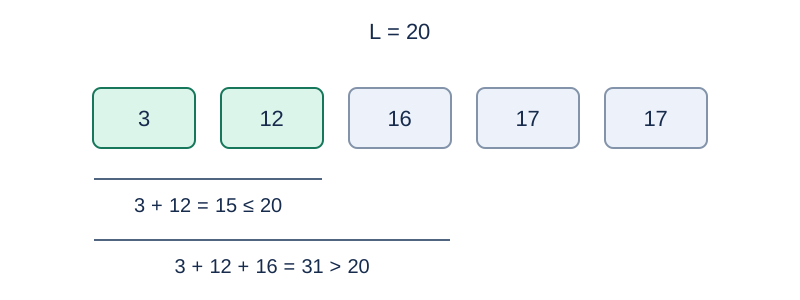
The minimum cost of two positions is 15; three positions cost at least 31.
Constraints and Guarantees
All data satisfy \(1\le n\le2\times10^7\) , \(|A|,|B|,|C|,|D|,|L|\le10^9\) , and \(D\ne0\) .
Specifications redesigned by Codex (GPT-6): the sequence recurrence, signed remainder, nonzero divisor, and output for an infeasible budget are explicit.
| Score | Additional conditions |
|---|---|
| 20% | \(n\le20\) |
| 30% | \(n\le100000\) |
| 50% | No additional conditions |